

Around the World Photos/Shutterstock
The 2027 Ford F-150 engine lineup includes three V6 EcoBoost configurations in addition to the 5.0-liter Coyote V8. The 3.0-liter EcoBoost provides 325 horsepower and 400 lb-ft of torque, the same as the 2.7 EcoBoost V6 it replaced. The 3.5 EcoBoost engine, meanwhile, offers 400 hp and 500 lb-ft of torque in the standard output version, 430 hp in the PowerBoost hybrid, and 450 hp in the high-output variant found in the F-150 Raptor.
For comparison, the naturally aspirated 5.0-liter Coyote V8 produces 400 horsepower and 410 pound feet of torque. In addition, there is a supercharger available for the 5.0-liter Coyote as a dealer accessory. While it’s technically not a standard engine offering, it is covered under warranty when purchased through a dealer. However, despite is power advantages, it’s not the best Ford F-150 engine option for towing,
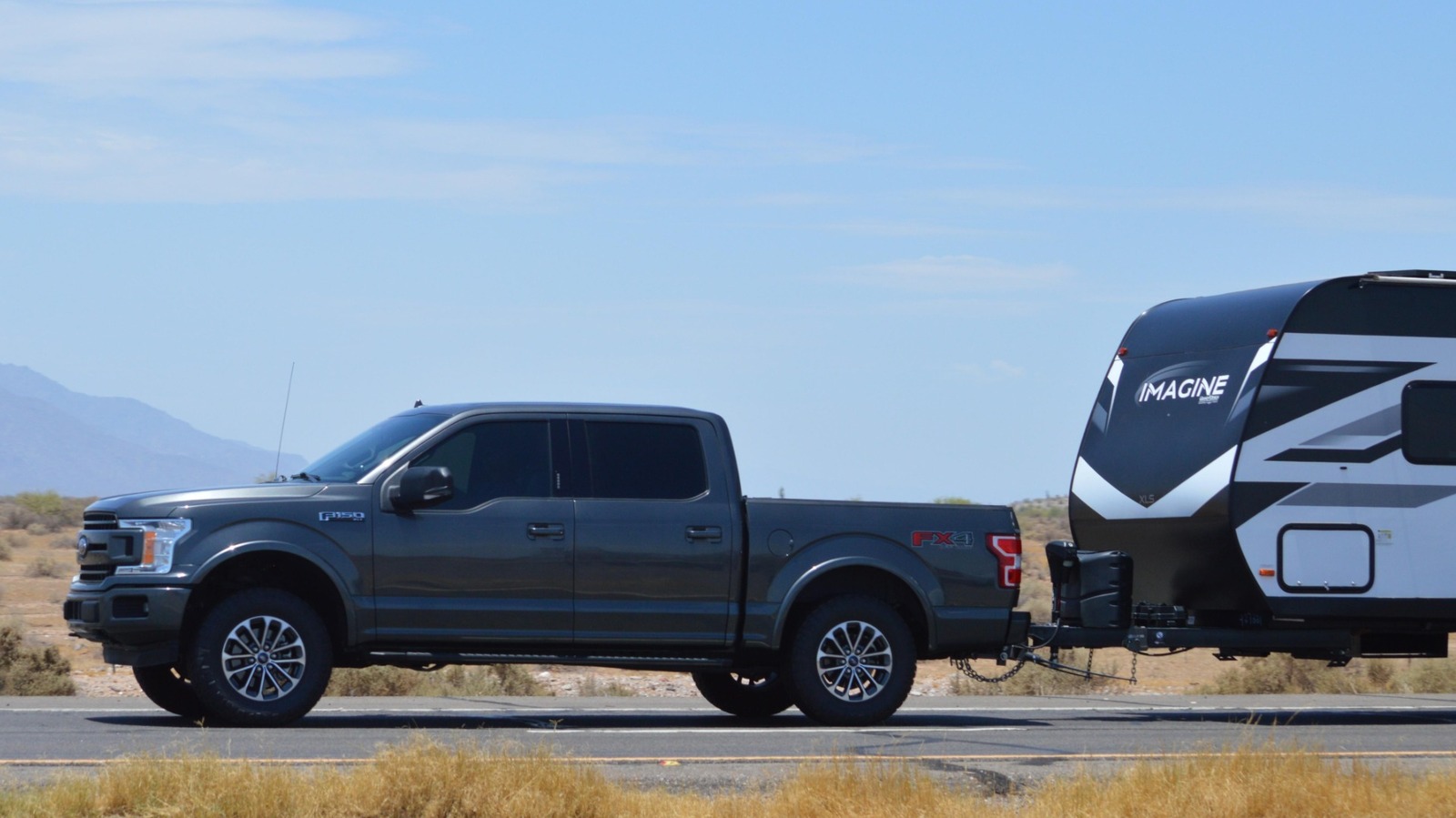
Although the standard-output 3.5-liter EcoBoost V6 and the naturally aspirated Coyote V8 offer the least power of their respective displacements, they hold the top ratings for F-150 payload and towing capacity. The twin-turbo 3.5 EcoBoost has higher ratings than the 5.0 Coyote for towing and payload capacity. Ford specs say a 2027 F-150 SuperCrew 4X4 with the 3.5-liter EcoBoost and all the tow/haul upgrades has a maximum conventional towing capacity of 13,500 pounds. The same configuration in a two-wheel drive F-150 SuperCrew yields a maximum tow rating of 13,300 pounds.
Compared to the 5.0-liter Coyote V8’s 12,800-pound maximum tow rating, the 3.5-liter EcoBoost has the advantage. That advantage carries over to payload capacity as well. The highest payloads for both engine configurations are available in the two-wheel drive F-150; 3.5-liter trucks can carry up to 2,440 pounds, while the Coyote-powered F-150 is slightly lower, at 2,235 pounds.
Some weaknesses of the Ford F-150 3.5-liter EcoBoost for towing
There’s no denying the power advantage of the 3.5-liter EcoBoost V6 for towing heavy loads. It also gets (slightly) better fuel economy, according to the EPA estimated ratings, with 20 mpg combined, compared to 19 mpg combined for the 5.0-liter Coyote V8 in two-wheel drive F-150s. The advantage is slight, calculating to a difference of 0.3 gallons to drive 100 miles, or about $1.20 with unleaded gasoline priced at $3.99 per gallon.
While you can use fuel economy as a point of reference for comparison, you shouldn’t obsess over EPA estimated mpg numbers, especially if towing is your primary concern. Differences in driving styles can negate any estimated advantage, but the 3.5-liter EcoBoost isn’t shy about guzzling fuel while it’s generating the extra power that makes it great for towing.
Getty’s Garage posted a video in 2024 comparing two nearly identical 2024 Ford F-150s, which were tasked with completing a 120-mile towing loop pulling an 8,000-pound enclosed cargo trailer. One had the 3.5 EcoBoost, the other one had the Coyote.
One uphill section saw the EcoBoost drivetrain shifting into 6th gear with rpm increasing to 3,100 to maintain speed. In the same section, the Coyote had to spin up to 3,600 rpm in 5th gear. Still, over the 120-mile loop the Coyote averaged about 7.1 mpg while the EcoBoost returned an average of 5.8 mpg, according to the trucks’ computers.
As a final thought about which engine might serve your towing needs the best, the Coyote V8 is much simpler. The EcoBoost relies on its turbochargers to produce the torque that makes it great for towing, but the higher complexity can lead to greater maintenance and repair costs.