
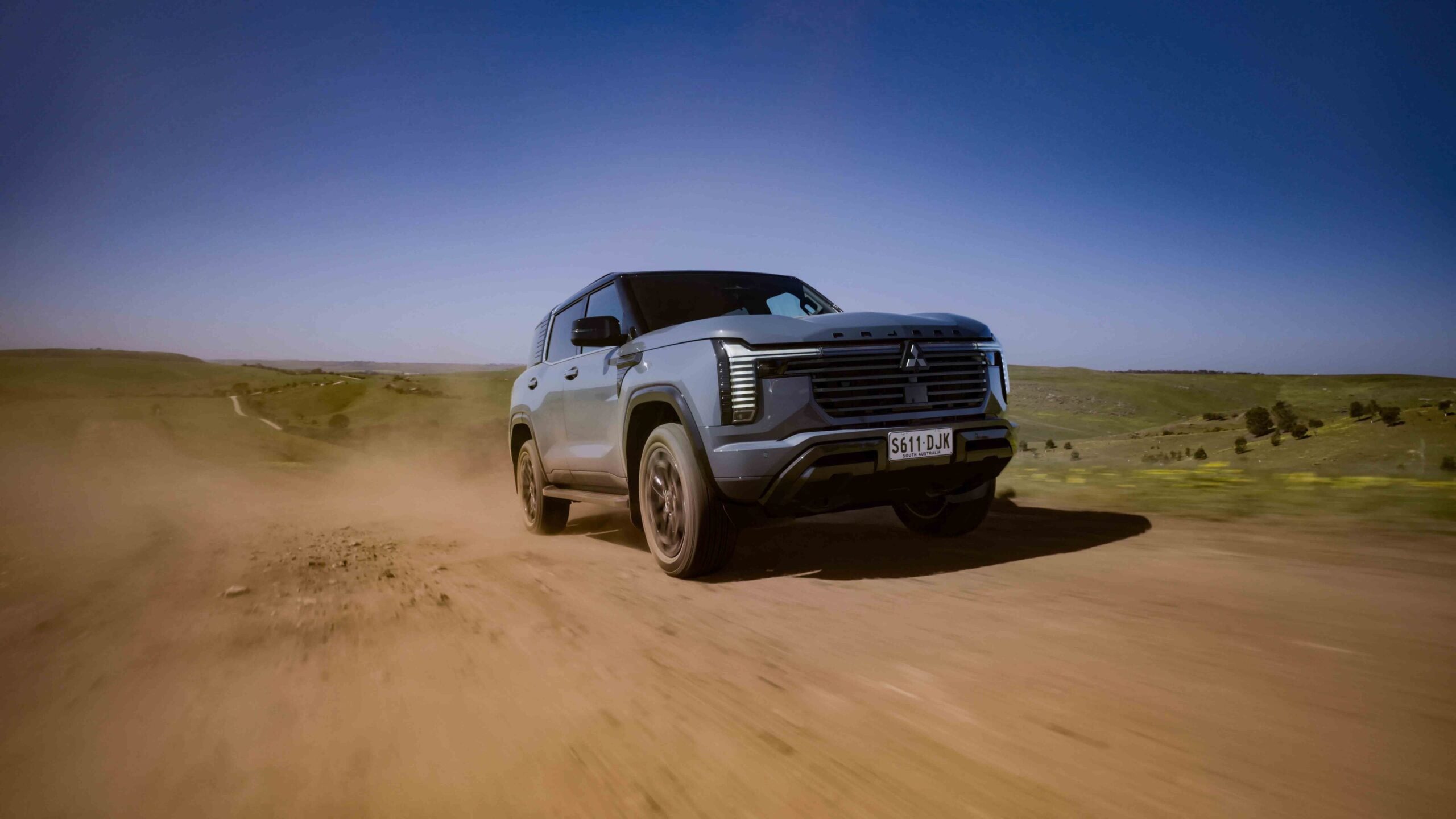
The legendary Mitsubishi Pajero is making its comeback before the end of the year with a new vehicle using a body-on-frame design, unlike the monocoque Pajeros of the last generation. That chassis is derived from the one under the current Triton ute, as is the four-cylinder diesel engine.
Five- and seven-seat variants will be available in local showrooms from December 2026, with the five-seat GLS priced at $68,490, the seven-seat GLS at $69,990, the seven-seat Exceed at $79,990 and the seven-seat GSR topping the range at $84,990 (all RRP).
The important news is what sits underneath. Every Pajero gets a dual-range transfer case, rear differential lock and Mitsubishi’s Super Select 4WD-II system, with 3500kg of braked towing capacity. So you don’t need to step up to the higher-spec models to get the important off-road hardware.

News
Mitsubishi confirms Australian pricing and specs for new Pajero
The all-new Pajero will return to Australian showrooms before the end of the year, priced from $68,490
September 3, 2026
Off-road performanceOur first taste of the new Pajero was in pre-production models at a four-wheel drive park in South Australia. We didn’t turn a wheel on bitumen and rarely saw more than 25-30km/h, so it was hardly a thorough evaluation.
But on the evidence of the dirt, this is the most convincing Mitsubishi in more than a decade (maybe two!) – and a giant leap for the Pajero nameplate. It takes a genuine step forward in off-road ability and an even bigger one in comfort and refinement.
We didn’t get the chance to experience the engine’s full fury, but what we did sample impressed. Throttle response is well measured, nicely calibrated for feeding in power over rocks and up steep pinches, and it works well with the eight-speed auto.

1
Arguably the biggest improvement is in refinement. The old Pajero – as loveable as it was – could get raucous, whereas the new one is quiet and smooth. It’s also noticeably more refined than the Triton, which uses a twin-turbo version of the same engine.
More ratios also bring benefits. First gear is shorter, something that pays off with engine braking on descents. While you’ve still got hill descent control as an electronic aid, you’re less likely to need it or to brush the brakes than in the previous car.
While the independent suspension and monocoque setup worked surprisingly well in the previous Pajero, the new one’s nod to tradition – a ladder frame with a live rear axle – steps things up considerably. There’s less chance of scuffing the metal underbody protection over rocks.

1
Wheel articulation has also headed in the right direction; the rear end in particular droops and compresses far more than the old Pajero’s, keeping tyres planted where the previous car would be lifting a wheel and scrabbling. In short, you’re less likely to need electronics because there’s more real traction to play with.
You can argue about the need for a 2H setting (Toyota doesn’t bother in the Prado), but Mitsubishi’s Super Select is as good as ever, with 2H, 4H, 4H Lock and locked low range. Pair that locking centre diff with a rear locker and there’s supreme traction. The traction control generally worked well, but on one cross-axle climb it couldn’t quite sort things out in the auto mode we’d left it in. Lock the centre and rear diffs, though, and the Pajero walked through without fuss.
If there’s one complaint, it’s forward vision; that bulky bonnet makes it trickier to place the front wheels on rocky climbs. Thankfully, technology helps, with the 360-degree camera and see-through bonnet system providing some digital visibility of what’s going on up front.
Electric power steering replaces the old hydraulic setup – and, as with the HiLux, Prado and others, the change is a revelation, making for far easier manoeuvrability. It’s lighter and requires fewer twirls to get the job done.

1
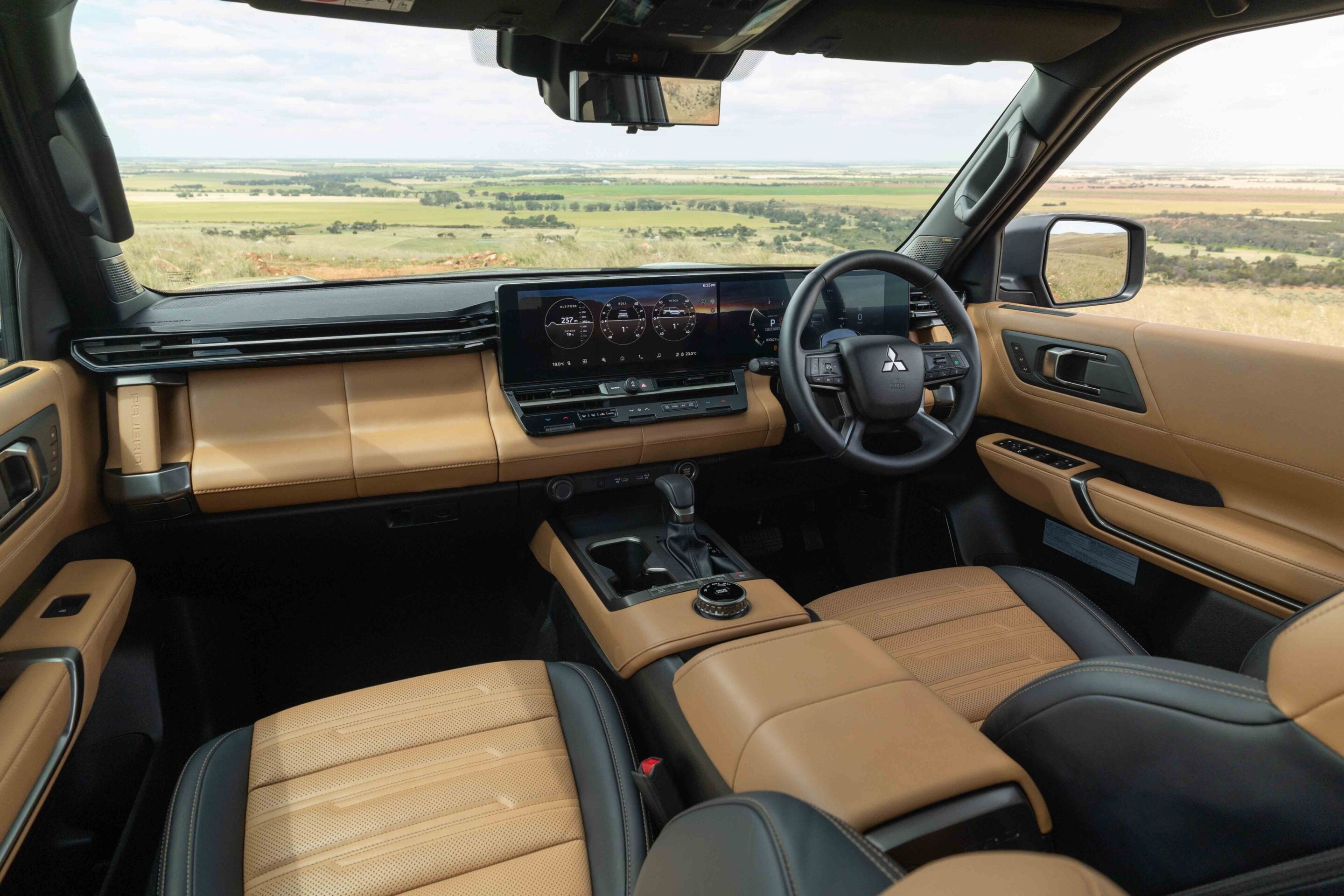
Interior and refinement Inside, the leap in the Pajero world is enormous. This is an off-roader that pampers.
It’s impressively quiet and refined, and the finishes, materials and modern pixel-infused layout are a big step beyond any other current Mitsubishi. It feels roomier than the photos suggest, too. Grab handles on each A-pillar and either side of the dash are handy for bracing yourself in the rough stuff or climbing aboard.
A digital instrument cluster flows into the central screen, and there’s a proper volume knob (hooray!). The iconic Mitsubishi multimeter has survived the digital transition, now as a screen showing your choice of three of six readouts: pitch, roll, compass, altitude, clock and Active Yaw Control. It’s handy, but it takes over the whole centre display and lacks the charm of the old dash-top gauges.
There’s a 150-watt household outlet in the second row (enough for a fridge or some lights, but not a kettle or toaster) and a 12-volt socket plus USB-C ports in the third row. The dual glovebox adds to the hidey-holes you can stuff things into.
When it comes time to clean out an air filter or check the fluids, there are gas struts to prop the bonnet up – a small detail that reflects the effort Mitsubishi has put into the new Paj. And, as with the Prado, the swing-out tailgate is gone in favour of a lift-up door, which means the full-size spare is now hidden underneath.
1
Engine and powertrainThe engine is the latest-generation version of Mitsubishi’s 4N16 2.4-litre four-cylinder diesel and produces 150kW and 480Nm, with a variable-geometry turbocharger in lieu of the twin turbos used in other applications.
Peak torque has increased by 10Nm over the previous application, while the new turbocharger is designed to improve midrange response, which should be useful for low-speed off-road driving and towing. The Pajero has a 3500kg braked towing capacity.
The engine uses a water-cooled intercooler, dual-loop EGR and AdBlue to meet Euro 6d emissions standards. Power is sent through an eight-speed automatic transmission to the Super Select 4WD-II transfer case.

1
VerdictAdd it all up, and on rough roads the new Pajero makes a sizable leap in the right direction.
Where the Triton felt like Mitsubishi simply adding another ute to the pile, the Pajero feels like the result of a company trying hard to unseat established rivals such as the Prado, Everest and MU-X while taking on the tsunami of new brands entering the 4×4 wagon market. The opposition is tough, but our first taste of the new Pajero suggests this is Mitsubishi back near its best.
The new Pajero will be launched in Australia in December, and we’ll have a full on- and off-road review for you then.Model range and pricingModelSeatsRRPPajero GLS5$68,490Pajero GLS7$69,990Pajero EXCEED7$79,990Pajero GSR7$84,990Safety featuresPassive safetyDriver and front passenger front and side airbagsFront centre airbagDriver knee airbagCurtain airbags for first and second rowsThird-row curtain airbags on seven-seat modelsThree second-row child restraint anchor pointsISOFIX child-seat mounting pointsActive safety and driver assistanceMiPilot adaptive cruise control with Lane Keep AssistLeading Car Departure NotificationMinimum Risk ManoeuvreTraffic Sign RecognitionIntelligent Speed LimiterAutomatic Post-Collision BrakingEmergency Call SystemForward Collision Mitigation with pedestrian and cyclist detectionPredictive Forward Collision MitigationRear Autonomous Emergency BrakingBlind Spot Warning and Lane Change AssistEmergency Lane AssistLane Departure Warning and Lane Departure PreventionEmergency Assist for Pedal MisapplicationFront and rear parking sensorsMulti Around View MonitorBonnet see-through cameraFront and rear Cross Traffic AlertDriver Attention AlertDriver Monitor SystemChild Presence DetectionAutomatic High BeamActive Yaw ControlActive Stability ControlAnti-Lock Braking SystemActive Traction ControlElectronic Brakeforce DistributionBrake Override SystemTrailer Stability AssistHill Start Assist

1
What do you get?Pajero GLS2.4-litre 4N16 turbo-diesel | 150kW/480NmEight-speed automaticSuper Select 4WD-IIRear differential lockSeven drive modes3500kg braked towing capacity18-inch alloy wheels with 255/65R18 Mud and Snow tyresFive- or seven-seat configurationWaterproof black fabric seats12.3-inch digital instrument cluster12.3-inch multimedia displayWireless Apple CarPlay and Android AutoWireless phone chargerMitsubishi CONNECTDual-zone front and automatic rear air conditioningElectric tailgateComfort and convenienceHeated steering wheelKeyless entry and push-button startElectric park brake with auto-holdRain-sensing wipersAuto-dimming rear-view mirrorPrivacy glassLED headlights, fog lamps and DRLsBlack roof railsGrey side stepsBlack wheel-arch mouldingsPajero EXCEED
In addition to GLS
20-inch machined alloy wheelsBlack leather seatsElectric front seatsHeated front and rear seats14.3-inch multimedia display14.3-inch digital instrument clusterRefrigerated centre consoleSecond-row sunshadesYamaha Ultimate 12-speaker audio system with amplifier and subwooferPajero GSR
In addition to EXCEED
20-inch black alloy wheelsTwo-tone camel and black leather seatsVentilated front seatsFront-seat, steering-wheel and door-mirror memoryPanoramic sunroofBlack headliningBlack exterior mirrors and wheel-arch mouldingsDark bumpersFront grille LED lightingDigital rear-view mirrorAdaptive Driving BeamNanoe X air purifier