
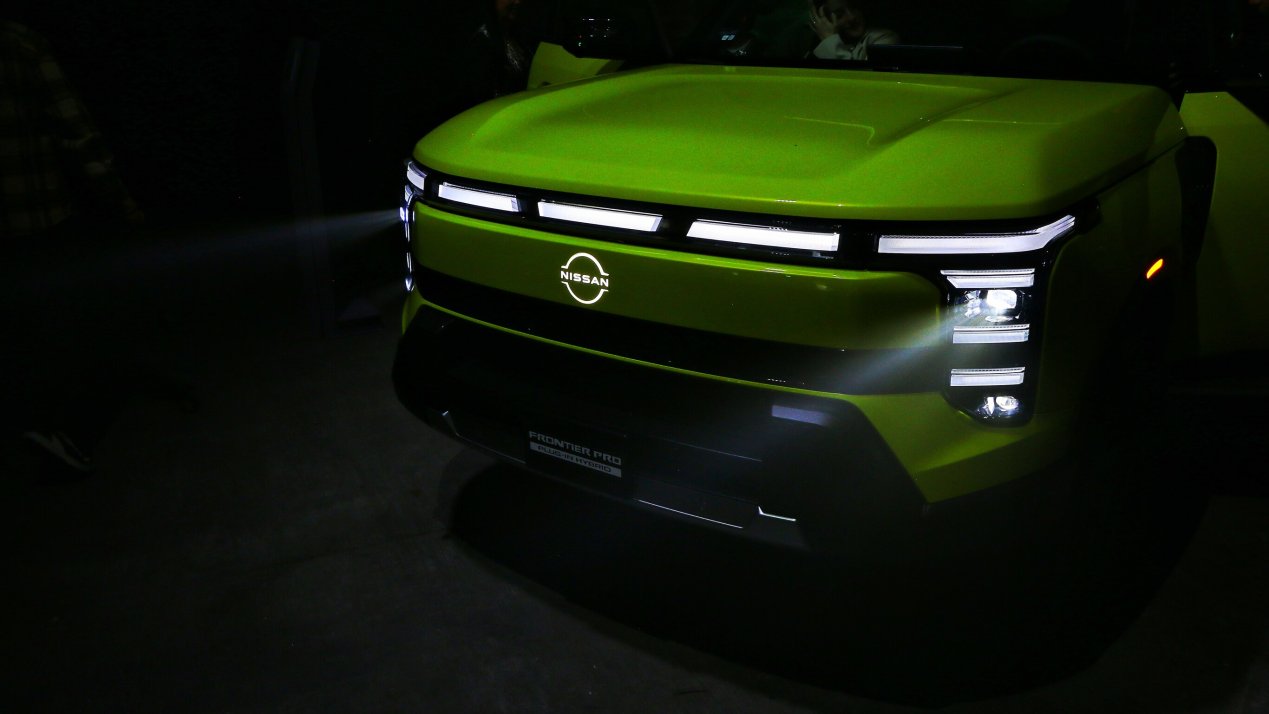
Nissan has officially introduced the Frontier PRO PHEV in Mexico, marking the automaker’s first plug-in hybrid electric pickup truck and its first vehicle designed, developed, and manufactured in China for global export.
Pricing for the new midsize pickup starts at MX$899,900 (US$48,683) for the base LE trim and reaches MX$969,900 (US$52,471) for the Platinum trim. Commercial rollout begins in Mexico before expanding to the Philippines in November, followed by additional markets across Latin America and the Middle East prior to the end of 2026. Nissan plans to launch the model in Australia and New Zealand in 2027.
The commercial decision to debut the vehicle in Mexico leverages the brand’s established footprint in the country’s pickup segment, serving as an entry point for a new lineup of electrified commercial and personal vehicles.
“When a model has a history like that of the Nissan Frontier, evolving it means understanding very well what our customers value about it,” said Rodrigo Centeno, president and managing director, Nissan Mexicana and INFINITI. “With the Nissan Frontier PRO PHEV, we are incorporating new technology without leaving behind the capability and versatility that have distinguished it for generations. For us, that is the way to take Frontier forward: adding more possibilities to a story that continues to grow.”
.jpg)
Manufacturing and Global Strategy
The Frontier PRO PHEV—which will be marketed as the Navara PRO in selected international regions—was engineered and built by Zhengzhou Nissan in China under the company’s global quality standards.
The vehicle represents a broader shift in Nissan’s operational footprint, utilizing its joint ventures and production capacity in China to serve international markets. The initiative falls under “Nissan Vision,” the corporate long-term strategy focused on customer-centric mobility solutions and electrified powertrains. As part of this export strategy, Nissan also announced plans to export the N7 electrified sedan from China to ASEAN markets and Latin America. The strategic platform includes a family of powertrains encompassing 1.5-liter and 2.0-liter plug-in hybrid setups as well as internal combustion engines, tailored to specific regional demand.
The import of the electrified pickup contrasts with Nissan’s conventional internal combustion engine (ICE) Frontier models, which maintain local manufacturing at the company’s Aguascalientes plant in Mexico following the closure of its CIVAC facility in Morelos.
“Nissan Frontier has accompanied customers across Latin America with very different ways of working, traveling, and enjoying the road for generations,” said Guy Rodríguez, president, Nissan Latin America. “With the Nissan Frontier PRO PHEV, we want that history to keep evolving, offering electrification and new technologies without losing sight of what people value in a pickup: trust, versatility, and the capability to respond when they need it.”
.jpeg)
Engineering and Technical Specifications
The hybrid system integrates a 1.5-liter turbocharged four-cylinder direct-injection gasoline engine producing 141 hp and 162 lb-ft of torque with a 209-hp electric motor generating 258 lb-ft of torque. Coupled with a 4-speed Dedicated Hybrid Transmission (4DHT), the combined system delivers 350 total horsepower and 660 Nm (487 lb-ft) of torque.
Energy is stored in a 20 kWh high-voltage battery pack mounted to the frame beneath the cargo bed. The vehicle offers an electric-only range of up to 75 km (NEDC) and a total combined range approaching 1,000 kilometers on a single 67-liter fuel tank. Fuel consumption running in hybrid mode is rated at 14 km/l in urban settings, 12 km/l on highways, and 13 km/l combined.
Vehicle tuning involved more than 100,000 km of testing conducted by Nissan’s Research and Development team in Mexico to calibrate the powertrain, five-link multilink rear suspension, double-wishbone front suspension, steering, and regenerative braking for regional high-altitude and off-road conditions.
“The powertrain testing evaluated acceleration response under different conditions, battery state-of-charge management, and high-altitude steep incline performance,” stated Humberto Gómez, Senior Director of Marketing, Nissan Mexicana, during the presentation.
The vehicle retains traditional off-road hardware, including four-wheel drive (4WD) with a transfer case, low-range gearing, and a rear locking differential. It features a payload capacity ranging between 815 kg and 865 kg, a towing capacity of 3,500 kg (3.5 metric tons), 232 mm of ground clearance, an approach angle of 30 degrees, a departure angle of 20 degrees, and a wading depth of 800 mm. Additionally, the system incorporates Vehicle-to-Load (V2L) technology alongside two 110V outlets and one 12V socket in the bed to power external equipment.
Dimensions and Interior Architecture
Measuring 5,494 mm in length, 1,960 mm in width, and 1,945 mm in height with a 3,300 mm wheelbase, the Frontier PRO PHEV is the largest midsize pickup in Nissan’s catalog, standing 3% larger, 6% wider, and 6% taller than the Frontier V6. Rear passenger doors swing open up to 90 degrees to facilitate cabin access.
Interior technology includes a 14.6-inch central infotainment display, a 10.2-inch digital instrument cluster, a 50W wireless charger, dual-zone automatic climate control, and four operational cabin profiles: Nap Mode, Camping Mode, Guardian Mode, and Car Wash Mode.
Safety configurations feature 10 driver assistance systems (ADAS) on the LE trim—including ProPILOT Assist and Autonomous Emergency Braking—while the Platinum trim adds nine additional safety systems, a 12-speaker 575W FOCAL audio system, heated and ventilated front seats with driver massage functions, and an integrated tow hitch package.