

Special operators from the Main Directorate of Intelligence of Ukraine (HUR) have conducted closed-door field trials of domestically manufactured quad bikes, focusing on platforms equipped with remote-control capabilities, the state defense technology cluster Brave1 reported.
The operational testing was carried out by combat operators from the 33 Group, a specialized detachment within the HUR’s Tymur Special Operations Unit. The reconnaissance personnel operated the vehicles directly across simulated tactical scenarios to evaluate handling, endurance, and field reliability, providing engineers with immediate technical feedback for modifications.
JOIN US ON TELEGRAM
Follow our coverage of the war on the @Kyivpost_official.
Brave1 stated that the evaluation was structured around operational criteria vital for autumn and winter frontline deployments, where unpaved terrain, mud, and intense drone surveillance complicate standard logistical operations.
The military requires versatile platforms that can transition between conventional driver operation and remote control to transport supplies, evacuate casualties, and conduct tactical resupply across contested sectors without exposing operators to direct enemy observation.
While the Armed Forces of Ukraine utilize foreign-manufactured all-terrain vehicles, cluster representatives noted that imported models carry high acquisition costs and lack organic remote-piloting capabilities. To address the gap, Brave1 has integrated unmanned quad bikes into a targeted grant program intended to foster an indigenous production ecosystem.
Other Topics of Interest
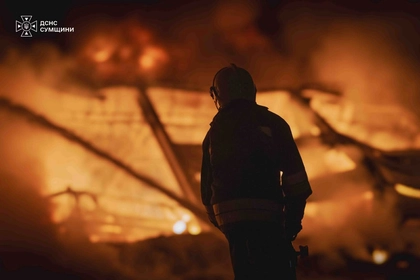
Russian Drone Strikes Ukrposhta Mobile Branch in Sumy
A Russian drone struck a mobile Ukrposhta post office van in Sumy region, injuring staff, according to Ukrposhta CEO Ihor Smilyanskyi.
“Our goal is to build a fully-fledged Ukrainian buggy market,” Brave1 said, noting that the cluster has provided financial grants to developers representing more than half of the buggy designs currently operating domestically.
Following the trials, manufacturers began refining transmission, communications links, and control software based on operator assessments. The defense-tech cluster noted that subsequent phases will involve coordination with the Ministry of Defense of Ukraine to codify the vehicles and scale serial procurement for frontline units.
Scaling domestic defense tech and indigenous munitions
The development of automated all-terrain vehicles forms part of a broader drive by Ukraine’s defense-industrial base and the Brave1 innovation cluster to field cost-effective, indigenously designed military hardware to counter Russian numerical superiority.
The initiative follows the unveiling in early September of the RK-19, a domestically produced surface-to-air missile engineered to replace dwindling Soviet-era munitions for Ukraine’s Osa-AKM mobile air defense systems.
The RK-19 missile, developed by Ukrainian state defense enterprises and showcased at the MSPO defense exhibition in Poland, was designed to substitute for Soviet 9M33-series interceptors.
The missile is engineered to intercept low-altitude aerial targets at distances of up to 10 kilometers and altitudes reaching 5 kilometers, reaching a maximum speed of 600 meters per second using radio-command guidance.
Ukrainian defense planners have accelerated domestic substitution programs as international munitions deliveries fluctuate and existing Soviet stockpiles approach exhaustion.
In late summer, Ukrainian officials noted that deliveries of foreign air defense missiles had fallen threefold compared with 2025 levels, prompting domestic developers to prioritize cost-effective interceptors and decentralized tactical platforms.
Brave1 developers have also introduced asymmetric countermeasures against high-speed aerial threats, demonstrating low-cost interception technologies designed to counter Russian loitering munitions and hybrid drone-missiles at a fraction of the cost of conventional anti-aircraft missiles.