

I’m in mid-air. It feels like I’m falling, everything’s a silent blur — and I’m holding a steering wheel. It could be a dream, except I’m extremely awake and extremely aware of where I am, what I’m doing, and that the ground is somewhere down there.
This is what a Ranger Raptor 1 does to you. Just walking up to it minutes beforehand made me grin. The huge knobbly tyres, big side steps and bright paintwork make it look like a grown-up version of the monster truck toys I put through awe-inspiring stunts around my bedroom as a child. And now that I’ve got the keys to this one and am strapping myself into its fighter jet-style seat, I get to do those jumps for real.


Ahead of me is a demonstration course laid out on the edge of the Salzburgring in Austria. It’s been specifically designed to show off the full breadth of Ranger Raptor’s ability — no mean feat — and it’s set to deliver more smiles per square metre than anywhere on the planet.
For many production vehicles, repeated runs around this course would be the last thing they ever do. Not Ranger Raptor. This pickup puts decades of Ford’s desert racing and rally knowledge into action, with the whole vehicle reworked to withstand the brutality of high-speed off-roading.
That includes a toughened frame, Raptor-only suspension and strengthened body elements. Ford engineers even beefed up the spare wheel mount. I’d love to know how they discovered that was necessary.
The suspension is a masterpiece. Trick dampers can change the stiffness of the suspension based on inputs from sensors monitoring the vehicle’s state 500 times per second. The stiffness can be different depending on whether the suspension is compressing or rebounding, and the intelligent system can recognise when Ranger Raptor is in mid-air and adjust the shock absorption for the ideal landing.
From behind the wheel, that level of flexibility means a single button lets you switch between comfy cruiser, pliable off-roader or tight, sporty setup in one truck. 2 The detail that went into delivering this performance is superb. Even the fluid in those dampers is infused with Teflon to reduce friction by 50 per cent. Yes, the same non-stick tech that means I can easily flip my weekend pancakes is now helping me navigate dirt bumps at speed.
A street-legal Ranger Raptor has won its class at the legendary Baja 1000 desert race — that’s 1000 flat-out miles of non-stop off roading — as well as setting a new production vehicle record at the Finke Desert Race across the Australian Outback. Compared to those, this Austrian hillside blast is nothing.
My co-pilot for the next two kilometres is Mark Bigwood, veteran of decades of Ford drive events and the man who worked with the Ranger Raptor engineering team to design and test this course. Mark’s also built and run a Ford Escort rally car to championship success before, so when it comes to getting airborne in a lairy Ford, he knows which way’s up. Which is handy, given what we’re about to do.
First things first, we don’t just point the Raptor at the nearest obstacle and go at full attack. Yes, this is a tough truck, but it still rewards deft hands and some intelligent use of its features. It’s so capable that it’ll handhold a novice like me through most of the course but there is one long gravel crest where, depending on our speed, it might briefly become a plane. Mark talks me through the whole course, how to position the pickup and what the ideal line is.

Step One — Setup
We go full attack with Baja Mode. This primes the suspension for maximum movement, gives me the sharpest and most aggressive throttle response and gearshifts, and opens up the exhaust so it functions like a straight-through system.
We also want to be in 4A mode. This means the Raptor intelligently sends torque to whichever wheels have the most grip, giving me maximum control and performance on changing surfaces. The steering and seat base let me feel the transitions from mud to broken concrete to gravel as we accelerate towards the crest. I keep my foot down and flick up a gear using the magnesium paddle by my right index finger.
“The Fox dampers on this are really special. Quite often you don’t feel the difference between being in mid-air and landing again”Mark Bigwood, drive experiences manager, Ford
Step Two — Steering
“Approach in a straight line, keep it there.” I do as Mark says. Any cornering as we near the crest would be exaggerated once in mid-air, so a straight run-up is crucial. He spent weeks shaping and testing the 70-metre gravel section: we want enough of a jump to show off the suspension, but not so much that it kicks the Raptor’s rear up high or risks loss of control.
Step Three — Air
Lift off the throttle once airborne. This keeps the truck settled and level as we clear the long gravel downslope below us. It also reduces the forces put through the transmission when we land and helps smooth the transition back to driving. The smart suspension knows each wheel is about to hit the ground again and will stiffen the suspension’s final 25 per cent of travel; that’ll stop us from bottoming out on landing, but keeps the initial touchdown soft enough to not fling us off the course.
Step Four — Remember to Brake
Controlling this much energy requires a fairly hard stop, so I’d mentally primed myself to hit the brakes after the landing bump.
Except there isn’t one. It’s smoother than the plane that brought me here. Those Fox dampers and long-travel suspension mean that bizarrely, landing is a non-event. It’s like skydiving on a sofa, and immediately I want to do it again.
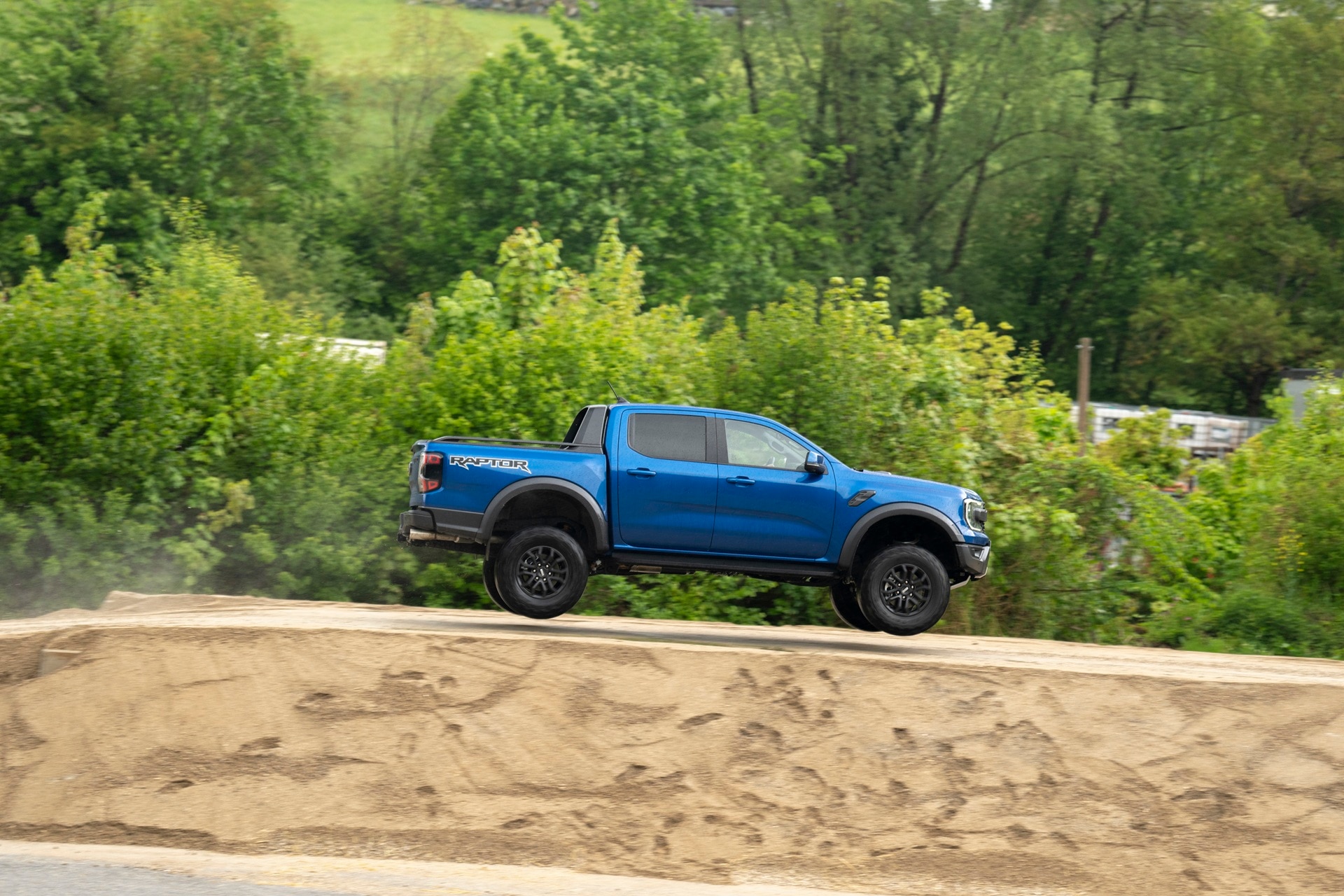
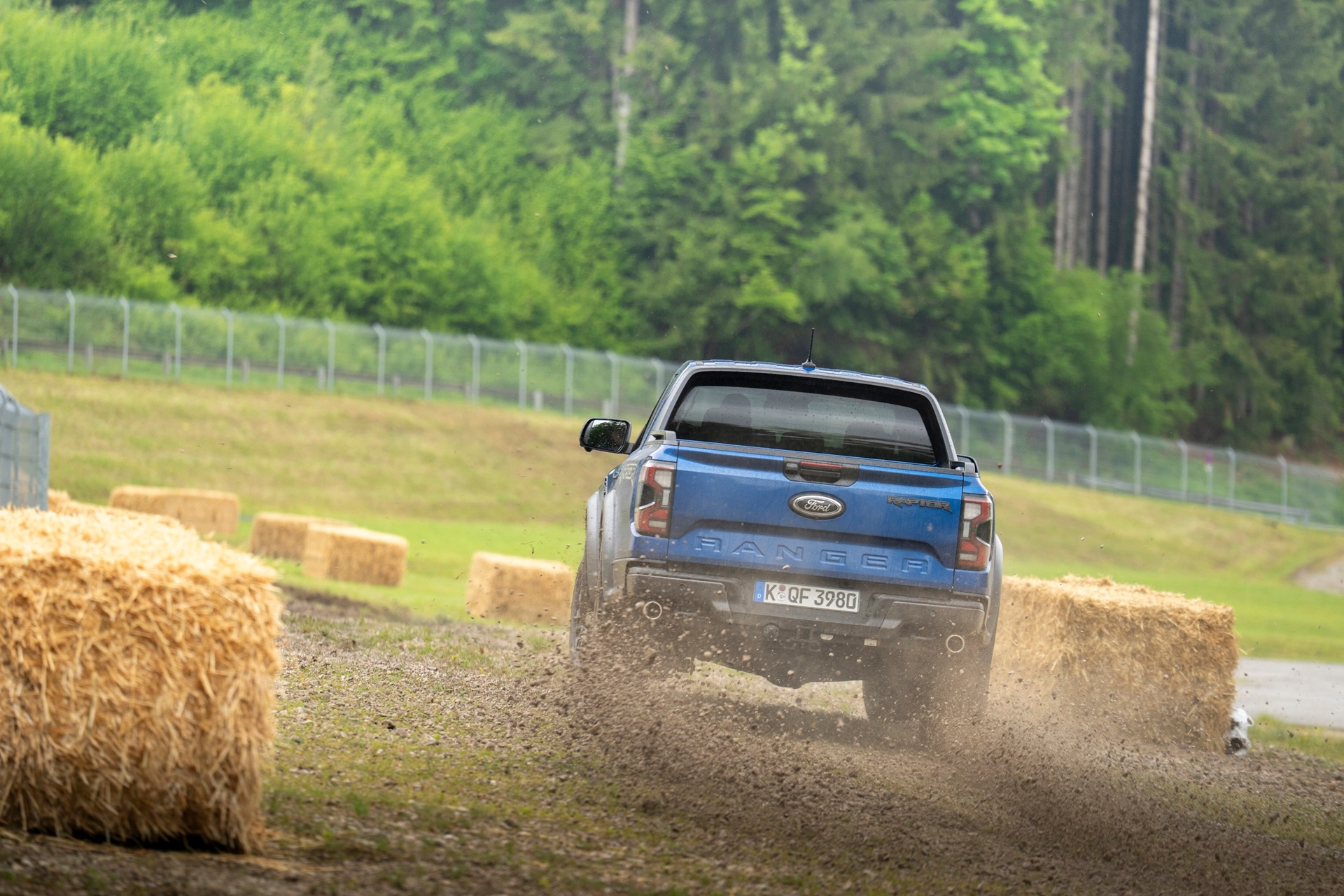 “It’s like skydiving on a sofa, and immediately I want to do it again.”Joe Morel, writer, From The Road
Run over, the vivid rush of what I’ve just done pours adrenalin into my nervous system. The Raptor ticks itself cool in the sun, absolutely nonplussed. It could have done exactly the same thing with over half a tonne of garden waste in the back 3 while streaming my favourite podcast through its 10-speaker B&O audio system. The load-anything, go-anywhere potential of a pickup is second to none.
Mark and his team will run three Raptors on the course all day, proving over and over again what they are capable of. By the end of the week, 700 people will have had the same mind-bending few minutes that I just have, and the fleet of pickups will have barely broken a sweat.
Joe Morel is a writer for From The Road.
Professional driver supervision on closed course. Always consult the Raptor supplement to the Owner’s Manual before off-road driving, know your terrain and trail difficulty, and use appropriate safety gear.
1 Ford Ranger Raptor homologated CO2 emissions 315 g/km WLTP, homologated fuel efficiency 13.8 l/100 km WLTP. The declared WLTP fuel/energy consumptions and CO2-emissions are determined according to the technical requirements and specifications of the European Regulations (EC) 715/2007 and (EU) 2017/1151 as last amended. The applied standard test procedures enable comparison between different vehicle types and different manufacturers.
2 Driver-assist features are supplemental and do not replace the driver’s attention, judgment and need to control the vehicle. It does not replace safe driving. See Owner’s Manual for details and limitations.
3 Max payload varies and is based on accessories and vehicle configuration. See label on doorjamb for carrying capacity of a specific vehicle. Always properly secure cargo.