
Hours after Washington publicly attacked Ford’s ties to Chinese automotive technology, a headline appeared in a Ford Fathom community: “Fathom Likely Killed in the Cradle.” The reaction captures how quickly the story changed around Ford’s $28,350 electric pickup, but it goes further than the evidence. Ford’s live consumer page still lists Fathom for 2027 at a $28,350 starting MSRP, with preorders beginning in early 2027.
Ford also did something important after the controversy erupted: it defended rather than abandoned the battery arrangement at the center of it. In its Sept. 8 response, Ford said its Michigan battery plant is Ford-owned and Ford-operated, employs American workers, and uses CATL through what the company describes as a limited technology-licensing and services agreement.

That does not amount to a fresh, post-controversy promise that Fathom’s price and launch date are untouchable. Ford’s response never mentions Fathom by name. But it makes a cancellation claim difficult to support today because the company is still publicly advertising the truck while simultaneously defending the CATL arrangement expected to help supply its batteries.
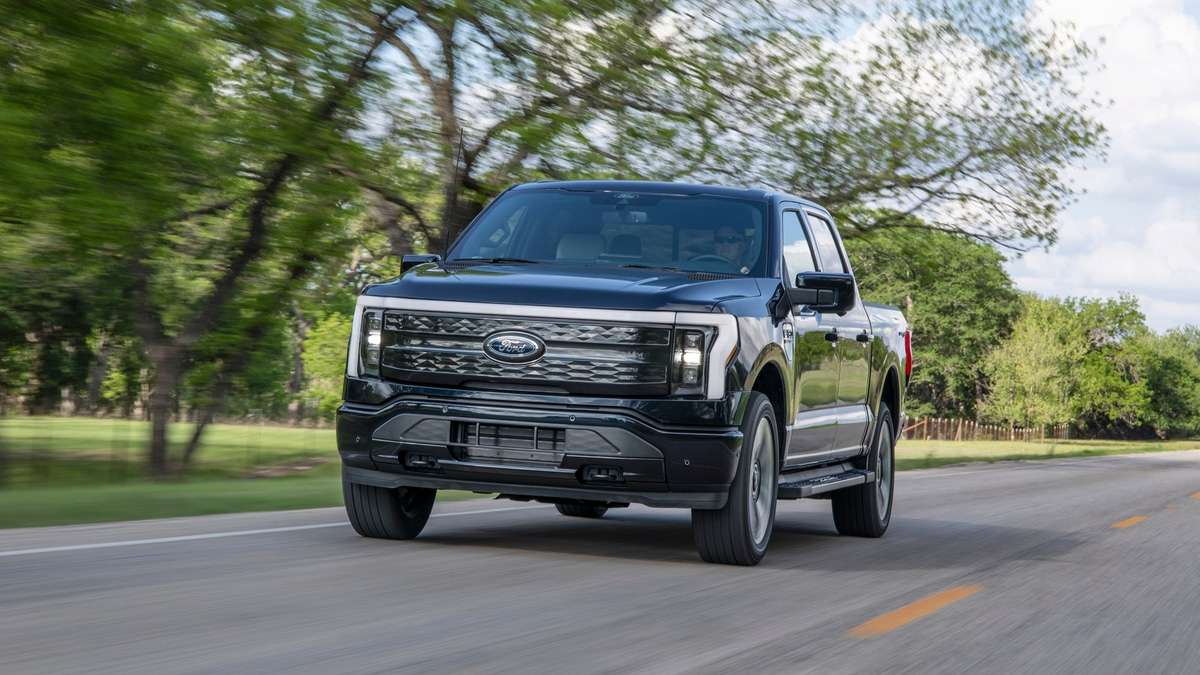
There is a reason Ford EV enthusiasts are jumpy. Production of the current battery-electric F-150 Lightning ended in 2025 as Ford redirected the nameplate toward a future extended-range electric version with a generator-backed estimated range above 700 miles. That history does not prove Fathom will follow the same path, but it helps explain why another Ford EV immediately became the subject of cancellation fears.
The Transportation Department’s Letter Does Not Cancel Fathom
The document that triggered this fight is much more specific than some of the reaction around it.
Transportation Secretary Sean Duffy wrote that the Department of Transportation had “profound concern” about Ford’s strategic direction and was “deeply alarmed” by the company’s continued use of CATL-licensed technology at BlueOval Battery Park Michigan. The letter also attacks Ford’s dealings with Geely, talks involving BYD, and continued Lincoln production in China.

But the distinction between political pressure and government action matters. The closing language says, “I urge you” to adopt strategies favoring American workers, allied supply chains and technological self-reliance. The letter does not order Ford to stop production at the Michigan plant, terminate CATL’s license, delay Fathom, change its batteries, or meet a compliance deadline. It does not identify a DOT enforcement action that would cancel the truck, and Fathom is not named in the letter.
The evidence does not show that Washington has killed Ford’s inexpensive EV pickup.
What it does show is more concrete: Washington has attacked a technology relationship sitting unusually close to the economics Ford is relying on to make that inexpensive EV pickup possible.
Fathom’s Connection to CATL Is Real
BlueOval Battery Park Michigan is not some distant Ford investment with a speculative connection to Fathom. Ford said in June that the LFP prismatic batteries being prepared there would power its affordable midsize electric truck, the first vehicle on the Universal EV Platform. The company also said the plant’s progress demonstrated the success of Ford’s work with CATL and that battery-production verification was following CATL practices.
That arrangement goes back to February 2023. Ford announced that a wholly owned Ford subsidiary would manufacture LFP cells in Michigan using battery-cell knowledge and services provided by CATL. Ford’s reason was straightforward: LFP chemistry could reduce costs and help make EVs more accessible without making the plant a CATL-owned joint venture.
That creates one of the strangest contradictions surrounding Fathom.
Ford developed its Universal EV effort because it concluded that the old way of building electric vehicles was too expensive. Its low-cost team was instructed to rethink design, supply chain, and manufacturing while benchmarking the best competitors in the world. In a September 2025 interview with The Verge, Jim Farley put the competitive threat in unusually stark terms: “The competitive reality is that the Chinese are the 700-pound gorilla in the EV industry.” He said Ford saw China’s combination of innovation, scale, and low cost as the benchmark it had to beat. In the same interview, he argued that a $30,000 EV that costs $50,000 to build is “not a sustainable business.”
In other words, Fathom is partly Ford’s answer to China’s cost advantage. One of the tools Ford chose to close that gap is Chinese-developed LFP manufacturing technology licensed for use in an American-owned plant.
Another U.S. EV maker chose a different hedge. Rivian CEO RJ Scaringe told The Verge in October 2025 that the company sourced R2 with “as little dependency as possible” on the Chinese supply chain because it expected a more domestic-centered manufacturing environment. He still acknowledged China’s structural cost advantage and advanced vehicle technology. R2 and Fathom are not an apples-to-apples cost comparison, but the contrast is useful: Rivian treated dependency itself as a design constraint, while Ford chose to localize production and license Chinese battery know-how.
Advertising
Now that exact relationship is under federal attack.
The More Powerful Federal Lever Is Not in Duffy’s Letter
The more consequential question is what could actually force Ford to change course if the Transportation Department letter itself does not cancel anything.
One answer already exists in federal law, and it is much more important than the rhetoric in the letter.
Ford’s own recent history shows why battery economics and federal incentives belong in this story. In August 2024, Ford canceled previously planned all-electric three-row SUVs, retimed its next-generation electric truck, and realigned U.S. battery sourcing to reduce costs and qualify for Inflation Reduction Act production and consumer tax credits. Farley summarized the logic in one sentence: “An affordable electric vehicle starts with an affordable battery.” He followed it with an equally blunt test: “If you are not competitive on battery cost, you are not competitive.”
In that same strategy update, Ford said BlueOval Battery Park Michigan was expected to qualify for Inflation Reduction Act benefits. After reducing the plant’s planned scale, Ford put annual LFP production capacity at approximately 20 gigawatt-hours.
Section 45X sets the federal production credit for qualifying battery cells at $35 per kilowatt-hour of capacity. At 20 GWh, that statutory rate corresponds to a theoretical $700 million per year of plantwide battery-cell credit capacity if the full 20 GWh qualified under the applicable rules.
That $700 million is not Ford’s disclosed tax benefit, and it is not $700 million that would automatically disappear if Washington objected to CATL. Actual credits depend on eligible production and sales, the applicable tax rules, sourcing, entity status and other requirements. It also should not be described as a Fathom subsidy because the Michigan facility can serve uses beyond one vehicle.
But the calculation does establish the scale of the economics Washington can potentially affect. Ford itself previously said the Michigan plant is expected to benefit from the production credit. That makes tax eligibility far more important to this investigation than whether one federal official dislikes Ford’s strategy.
CATL Now Matters to Those Tax Rules in a New Way
Federal law changed after Ford originally signed its CATL agreement.
Treasury and IRS guidance issued this year applies new prohibited-foreign-entity restrictions to Section 45X. An eligible component can become ineligible if it contains material assistance from a prohibited foreign entity under the applicable cost-ratio rules.
The rules also define a prohibited foreign entity to include a “specified foreign entity.” One route into that category is appearing on the Defense Department’s Section 1260H list of Chinese military companies operating in the United States. CATL is on the current 2026 list. CATL disputes that designation, says it has never engaged in military-related activities, and says it is pursuing removal from the list.
The licensing rules are where Ford’s situation gets particularly interesting.
Treasury’s guidance says a U.S. company can be considered foreign-influenced when a payment to a specified foreign entity is made under an arrangement that gives that foreign entity “effective control” over production. For licensing deals, the statute identifies things such as rights over component sourcing, operation of production equipment, limits on the licensee’s use of intellectual property, long-running royalty rights, required services and whether the American licensee receives enough knowledge to operate independently.
There is also an especially clear date test. The guidance says that a qualifying licensing arrangement entered into or modified on or after July 4, 2025 can itself trigger the effective-control rule described in the statute.
That sounds disastrous for Ford until one crucial date is added.
Ford announced its CATL licensing arrangement in February 2023, more than two years before July 4, 2025.
Advertising
That means the public record does not support saying Ford automatically loses Section 45X because it licenses CATL technology.
An older agreement could still face other PFE or material-assistance tests depending on its terms and supply chain. What matters is what CATL actually controls, what inputs come from prohibited entities, and whether the agreement has subsequently been changed in a way that affects the new rules.
Congress was already asking exactly that question months before the Duffy fight. In January, House China Committee Chairman John Moolenaar asked Ford whether the CATL licensing arrangement had received “amendments, expansions, or new scopes of work” since July 4, 2025 and whether Ford intended to claim Section 45X or related credits for products using the licensed technology.
Ford, for its part, has publicly expressed confidence in its position. At a June UBS automotive conference carried on Ford’s investor calendar, CFO Sherry House said the company was drawing on the same licensing agreement used for Marshall and believed it remained eligible under the current production-tax-credit language. That matters, but it remains Ford’s interpretation of its tax position rather than a public IRS determination on this specific plant and contract.
So Where Does That Leave the $28,350 Fathom?
There is considerably more evidence of an active vehicle program than of a canceled one.
Ford transformed the Louisville Assembly Plant around its new Universal EV Production System and said in August that Fathom remained on track. Its current consumer page still says the truck arrives in 2027, starts at $28,350 with a standard-range battery and opens preorders in early 2027.
The important qualification is timing. Ford made its detailed factory and launch statements before the Sept. 8 confrontation, and its response to Duffy did not separately reaffirm Fathom’s exact price, battery sourcing and launch date. That is why “Ford still lists” is more defensible than saying Ford freshly guaranteed every element of the program after the controversy.
It is also why declaring Fathom dead now would miss the more interesting story.
Ford built this vehicle around an attempt to produce an affordable American EV without accepting the cost structure that helped derail its previous generation of electric programs. It chose American production, a radically different assembly system and low-cost LFP chemistry, while licensing technology from the company Ford considered capable of helping it compete at a global level.
Washington has now put political pressure on that compromise.
The immediate evidence does not show that Fathom has been canceled, that Ford has changed its 2027 schedule, that its Michigan batteries have been removed from the truck, or that BlueOval Battery Park has lost Section 45X eligibility. Those conclusions would all outrun the evidence available today.
What has changed is the risk surrounding one of Fathom’s most consequential cost strategies.
For now, the $28,350 Fathom is still sitting on Ford’s own website with a 2027 date attached to it. The harder test may come before anyone drives one: whether Ford can preserve the economics of American-made, CATL-licensed LFP batteries while satisfying a federal government increasingly determined to reduce the auto industry’s technological dependence on China.
What do you make of Ford’s direction here? If you were waiting for this vehicle, would you still give Ford’s replacement strategy a chance, or has the company lost you? Let us know what you think in the comments.
About The Author
Noah Washington is an automotive journalist based in Atlanta, Georgia, covering sports cars, luxury vehicles, and performance culture. His reporting focuses on explaining the engineering, design philosophy, and real-world ownership experience behind modern vehicles.
Noah has been immersed in the automotive world since his early teens, attending industry events and following the enthusiast communities that shape how cars are built and driven today. His work blends industry insight with enthusiastic storytelling, helping readers understand not just what a car is, but why it matters.
Noah is also a member of the Southeast Automotive Media Association (SAMA), a professional organization for automotive journalists and industry media in the Southeast.
His coverage regularly explores sports cars, luxury vehicles, and performance-driven segments of the automotive industry, including the evolving culture surrounding Formula Drift and enthusiast builds.
Read more of Noah’s work on his author profile page.
You can also follow Noah here:
Follow us today…


