
America’s EV strategy is lurching. Policy reversals, people’s hesitations, and automakers scrambling to protect their balance sheets have turned what was supposed to be a clean, steady sprint toward electrification into a messy, uneven stumble.
The Numbers Look Bad, but They Don’t Tell You Who Actually Pulled Back First
For a moment, the U.S. EV market looked unstoppable. A record 1.6 million EVs sold in 2024 suggested the country had crossed a real turning point. Then came the reversal. After the federal EV tax credit expired, sales slipped, and by the first quarter of 2026, EV sales had fallen 27% year over year, shrinking to just 5.8% of the new car market, according to industry sales data reported by multiple outlets tracking the segment.
It would be easy to read that drop as buyers simply losing interest. Researchers at the UC Davis Institute of Transportation Studies argue that’s only part of the story. Their analysis found that softened demand accounted for less than 20 percent of the decline, while what they describe as a broader supply-side retreat, meaning manufacturers pulling back from production plans rather than customers walking away, explains a much larger share of the drop.
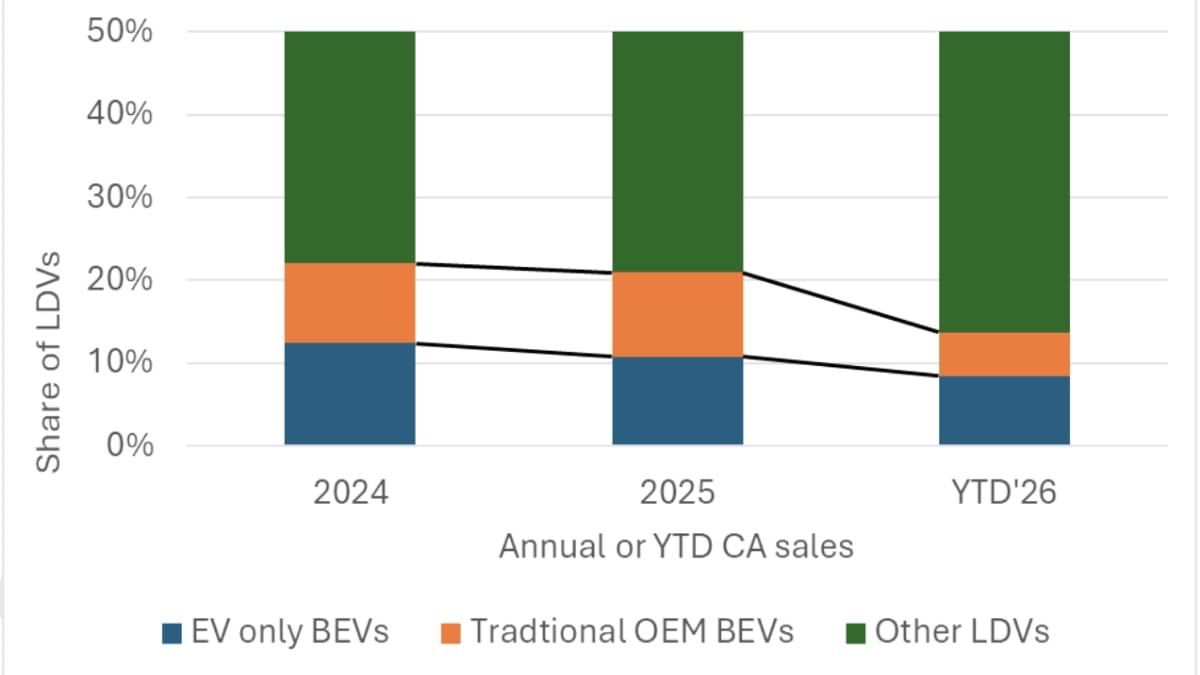
In other words, according to UC Davis’s own reading of the data, Americans didn’t necessarily abandon EVs on their own. Automakers pulled inventory and canceled programs ahead of them.
Policy Whiplash Set Off the Biggest Coordinated Pullback the EV Industry Has Seen
Advertising
Federal policy changes between 2025 and 2026 didn’t just slow momentum. They detonated it. The expiration of the EV tax credit, frozen charging network funds, zeroed-out CAFE penalties, and the repeal of federal tailpipe emissions standards combined to force a massive write-down on billions of dollars in prior investment, a fairly predictable outcome once manufacturers stopped facing regulatory pressure to keep building toward electrification targets.
Automakers responded the way large companies generally respond to sudden uncertainty: they protected themselves first. The result was roughly $53 billion in combined EV write-downs as programs were canceled or delayed.
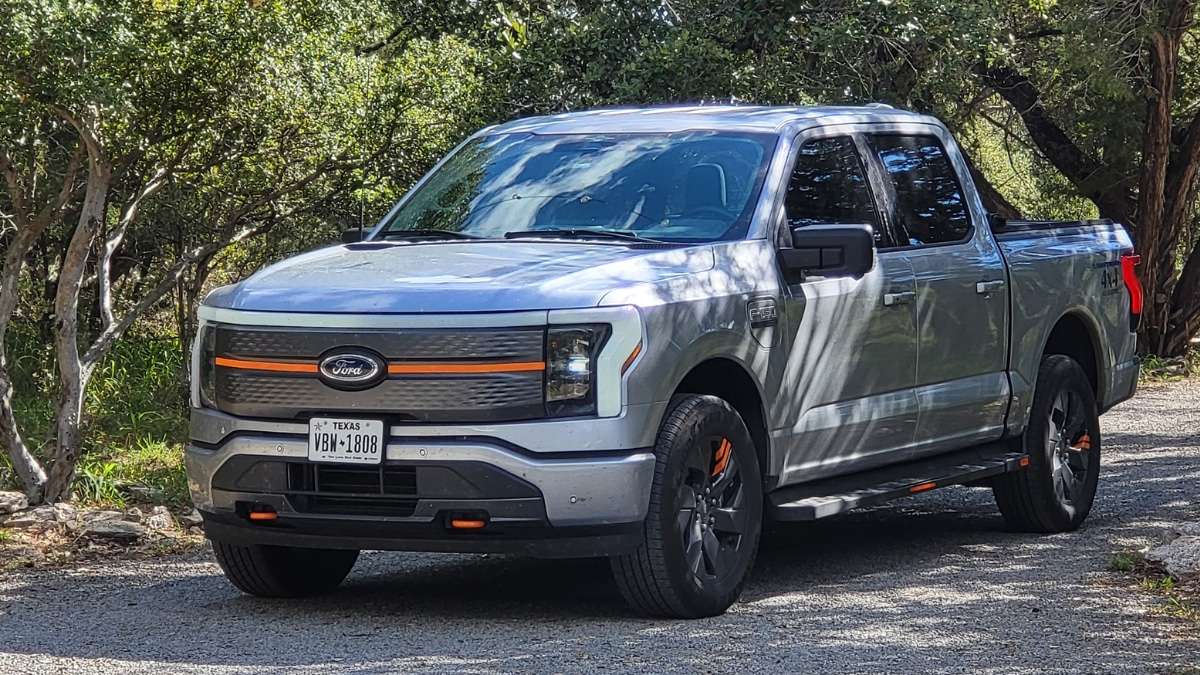
Ford scrapped the F-150 Lightning after posting a 71% year-over-year EV sales decline in February alone. Stellantis canceled its all-electric Ram pickup entirely, shifting instead to a range-extended hybrid version. GM has delayed or reduced production of its full-size EV trucks. Volkswagen ended U.S. production of the ID.4. Honda canceled several planned EV models, and reported its first full-year loss in company history around the same period. Volvo dropped its EX30.
That’s not what a normal market correction looks like. It reads much closer to a coordinated retreat, with multiple large manufacturers pulling back within the same narrow window rather than each independently responding to their own isolated sales data.
EVs Aren’t Dead, but the Industry Just Got a Lot More Cautious
None of this means the U.S. has abandoned electrification altogether. What’s happening looks more like a recalibration than an outright reversal. For the first time in years, EVs are meaningfully closer to affordability, with price cuts and cheaper models arriving across multiple brands that should attract buyers who were previously priced out. Battery costs have fallen to their lowest levels on record, making electric powertrains increasingly competitive against comparable gas models on a pure cost basis.
Advertising
Even amid the broader retreat, U.S. battery and EV factory investment hasn’t stopped entirely. Ford, Hyundai, and GM continue putting money into domestic production, and Toyota, arguably the most surprising name on that list given its historically cautious approach to full electrification, has announced plans for seven EV models in the U.S. by 2027 alongside new solid-state battery development milestones that could meaningfully change the competitive picture if the technology reaches production on schedule.
What Comes Next Depends on How Many Obstacles the Industry Actually Has to Clear
2026 wasn’t the EV boom year many expected a few years ago. It was closer to the year the industry sobered up. The flashy, oversized, luxury-first EV wave that defined the early rollout is giving way to a more pragmatic push toward vehicles that are actually affordable to build and actually profitable to sell.
The broader shift toward electrification still looks inevitable over a long enough timeline, but it’s clearly no longer a straight line. The real question isn’t whether the EV transition eventually arrives. It’s how many political, economic, and industrial obstacles it has to climb over first, and how many more manufacturers decide the safer move, at least for now, is to step back rather than push forward.
Do you think the $53 billion in canceled EV programs reflects a genuine, lasting shift in what American buyers actually want, or a temporary overcorrection tied to one policy change expiring at a bad moment? And if you were shopping for a new vehicle right now, has this wave of cancellations, from the Lightning to the Ram REV to Honda’s canceled lineup, changed which brand you’d actually consider? Tell us where you land in the comments below.
About The Author
Blake Lowry is a tech forward automotive enthusiast with a background in software development and animation working with clients such as Car & Driver, Hot Wheels, Google, Microsoft and the History Channel where he contributed on various interactive experiences. Blake’s automotive passion is centered around electric cars and trucks, alternative/green energy and practical applications in the real world. At Torque News, Blake’s articles focus on Ford F-150 Lightning, Rivian R1T, Tesla Cybertruck, Chevrolet Silverado EV, GMC Sierra EV, and GMC Hummer EV Pickup coverage.
Read more of Blake’s work on his author profile page.
You can also follow Blake here:
Follow us today…


