


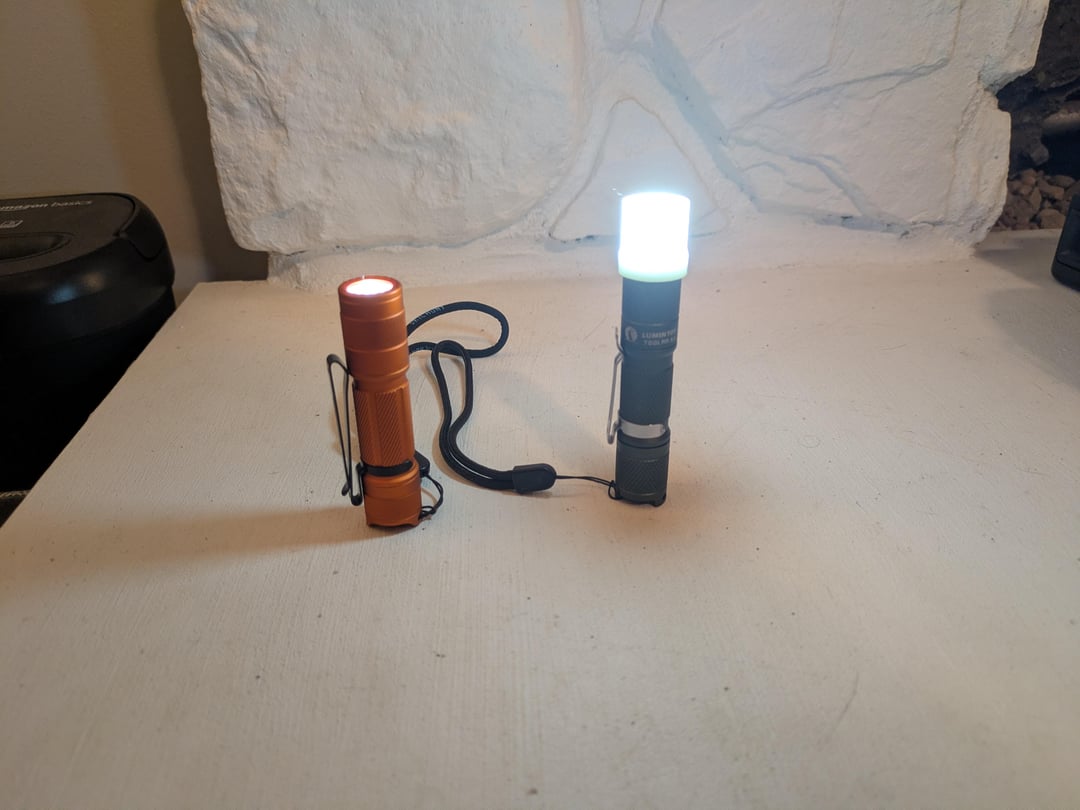

On the spectrum of casual-to-enthusiast, I lean closer to the casual side. My sweet spot is a single-AA sized pocket light with a few simple light modes. After my Thrunite Saber began having issues, I tried two alternatives in a similar price range: the Lumintop Tool AA 3.0, and the Skilhunt E2A.
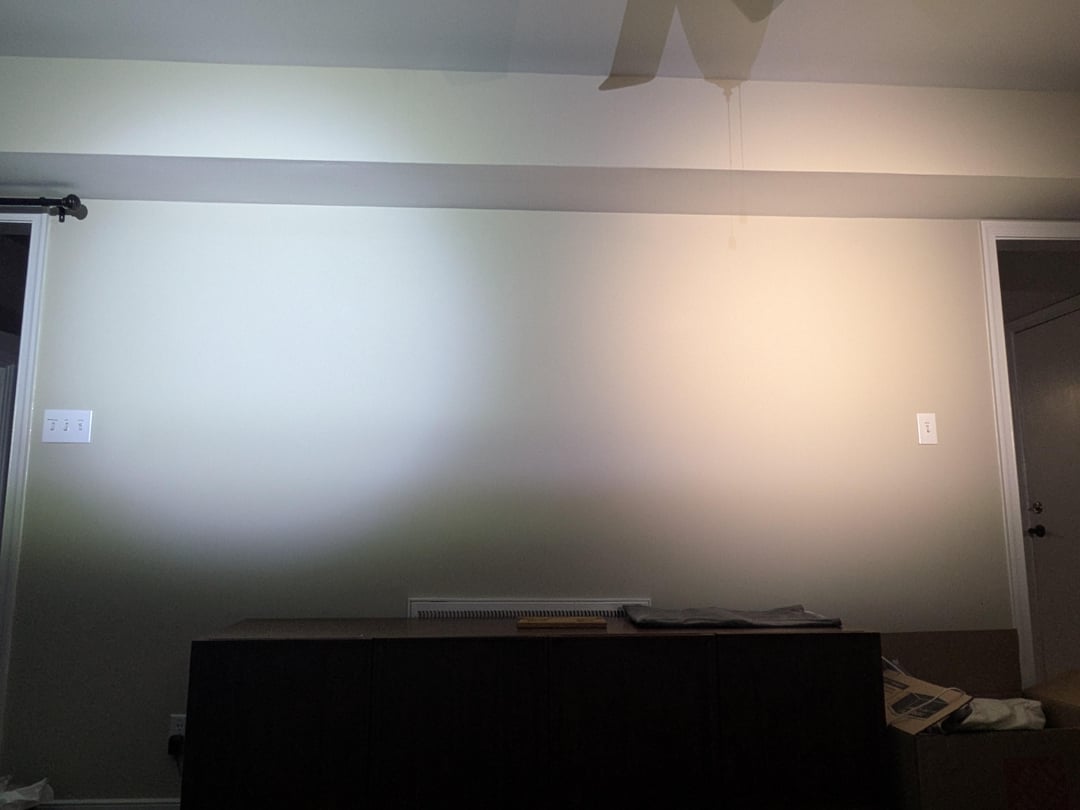
The comparison isn't totally apples-to-apples. The Tool 3.0 was released several years after the E2A, with an upgraded emitter. I also picked the high-CRI version of the E2A, so I will be comparing a "cool white" beam to a neutral-tint one.
Initial impressions
At the time of this review in 2026, both lights retail for $20-30 on Amazon with a battery included.
The E2A came with extra o-rings, a 1300mAh lithium 14500 battery with onboard USB-C charging, a reversable belt clip, and a lanyard.
The Tool 3.0 came with extra o-rings, a 1000mAh lithium 14500 battery with onboard USB-C charging, a reversable belt clip, a lanyard, a glowy diffuser tip, and a magnetic tail cap as an alternative to the clicky switch.
Both lights have an aluminum body with a tail cap and an emitter that screws on. Lumintop makes their tailcaps swappable, while Skilhunt glues theirs on (not that you would have much reason to remove it). Their sizing is nearly identical, with the E2A being slightly shorter and thicker. Both lights feel good in the hand. The E2A will work with flat-top 14500 batteries; the Tool 3.0 will only work with protected (button-top) cells.
A rough start for Lumintop: The first Lumintop Tool light I received was a lemon; the clicky tail switch stopped working within the first five minutes of use. After an email to Lumintop Support went unanswered for several days, I exchanged the light for a new one via Amazon. The replacement came with all of the accessories the previous one did… except the extra o-rings were missing! While this is one anecdote, it did not inspire confidence in the Tool 3.0's durability, nor Lumintop's QC or customer service. Then again at a price of $25-30 in 2026 for all these features, I may be getting what I paid for.
Interface
- Tool 3.0: Full click on/off, half-press low | medium | high | turbo(3m) > high, half-press 6x = strobe
- E2A: Full click on/off, half-press low | medium | turbo(1m) > high
If I could describe the Tool 3.0's interface in a word, it would be: fussy. There is a half-second lag between mode changes, and if you try to change modes too quickly it will simply wink and stay at the same level. However, six half-presses in a row will trigger strobe mode- so fussing with the light modes can result in bouts of epilepsy and swearing.
The E2A's interface is simpler and more responsive. There is no lag between mode changes, and the stiffer tail switch prevents accidental presses. You get low / medium / high, and that's it. The high mode will give you a minute of turbo at 600lm before stepping down.
Both lights have mode memory, and I wish they didn't. It makes using them indoors a squinty endeavor until you get the desired mode dialed in. Moonlight mode is absent on both lights, but with an AA battery your low mode would get close to that.
Light modes and performance
The Tool 3.0 was released several years after the E2A, and it boasts an upgraded emitter. On paper, the difference seems stark. Worth noting is that Skilhunt based their 14500 runtimes on a 800mAh battery for the E2A, but the light itself came with a 1300mAh battery. As you would expect, I saw longer runtimes for the E2A with the larger battery.
Lumens vs runtimes, from the manuals for both lights:
| Light + batt | Low | Medium | High | Turbo | Strobe |
|---|---|---|---|---|---|
| Tool 3.0 14500 | 20 (37h) | 150 (4h) | 500 (1h10m) | 900(3m) > 500(1h) | 500 |
| E2A 14500 | 15 (25h) | 120 (3h20m) | 600(1m) > 260(1h20m) | N/A | N/A |
| Tool 3.0 NiMH | 4 (60h) | 30 (12h) | 150 (3h) | 300 (1h) | 150 |
| E2A NiMH | 5 (48h) | 40 (4h30m) | 200(1m) > 120(1h20m) | N/A | N/A |
Smarter people than me have published runtime graphs for each light, and my amateur testing found similar results. In short, the Tool 3.0 favors high starting output, while the E2A favors consistent output.
I ran both lights on high mode until they gave out. The E2A kept a pretty consistent output until the very last minute, when the beam fell off with little warning. I had swapped in a 1000mAh battery to better reflect the reference runtimes in the manual, and the E2A still outlasted their published numbers by ~15 minutes. Meanwhile the Tool 3.0 beam started very strong, but quickly lost brightness at a smooth and steady rate. I considered it "done" when it dropped into a moonlight mode and stayed there for a while. The total runtime at high was slightly less than published for the Tool 3.0, at about 1 hour vs 1h10m. The Tool's runtimes could be improved further by swapping for a 1500mAh battery (only button tops are supported).
When switching to NiMH AA batteries, output was very consistent for both lights, and stayed steady until the batteries ran out. The Tool's advantage on paper was more true-to-life here, with runtimes that simply outpaced the E2A in every mode.
A polarizing feature- Lumintop's lighted tail switch
The Tool 3.0's tail switch has some RGB lights that are always on while a 14500 battery is inserted. They glow with a shifting rainbow pattern, which I am told will turn solid red if the battery is near dead (forgot to check this when testing, sorry!) The price you pay for this neat effect, is some parasitic drain. According to measurements taken in this review, the lighted tail switch will drain the included 1000mAh battery within 6-7 weeks on its own.
There are ways to avoid the tail switch drain. You can unscrew the top slightly to lock out the light; you can use a standard AA battery; or you can switch to the magnetic tail cap.
Summary
I like both lights for different reasons. The Tool 3.0 has some great features and performance stuffed into a small and affordable light, and better runtimes in many areas thanks to a newer emitter. But for every feature I liked on the Tool 3.0, there were rough edges elsewhere that curbed my enthusiasm. These issues wouldn't stick out as much if reviewing in a vacuum… but I was comparing it to the E2A, which was relatively fuss-free.
The E2A didn't wow me in any one area (maybe beam quality?), but the behavior was more refined and consistent all-around. I honestly had a tough time coming up with reasons to dislike it. The light was designed in 2021, so it may be behind in some areas compared to newer models from competitors- but in terms of everyday performance, it didn't feel lacking.
Tool 3.0 pros/cons
- + Many features included out of the box
- + Great initial output on a full charge with 14500. Three minutes of sustained turbo!
- + Long runtimes on AA
- + Everglow tail switch is cool when I want it (camping, travel, power outages)
- \= No moonlight mode
- – Fussy mode selection, and strobe mode is bananas
- – Output starts high but tapers off quickly with 14500
- – No thermal regulation. Light gets HOT in the first few minutes of high/turbo
- – Everglow tail switch is annoying when I don't want it (AKA most of the time)
Skilhunt E2A pros/cons
- + High-CRI beam looks nice
- + Robust construction and simple/responsive UI
- + Consistent regulated output with both 14500 and AA
- \= No moonlight mode
- – Not much warning before battery is spent
- – Older emitter (~2021), better lights may be out there in this price range
I can see either light having a loyal following. Despite the Tool 3.0 having some better specs on paper and longer runtimes in some areas, the Skilhunt E2A won me over for its build and its consistent performance.
by SheistyPenguin