
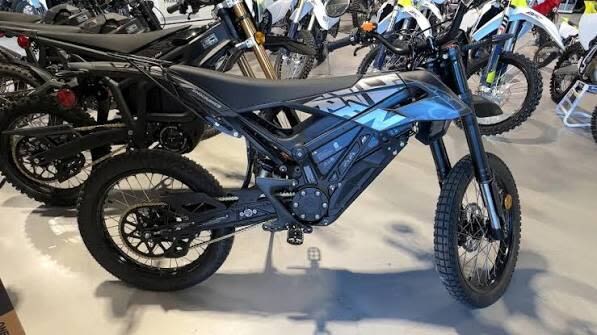
Police in the Kennebecasis Valley are sounding the alarm on a surge of electric dirt bikes they say are putting both pedestrians and young riders in danger.
The vehicles are nearly silent, capable of hitting speeds over 70 km/h, and increasingly common on public sidewalks and streets.
“We’re looking at that in-between age of preteens or teens that aren’t licensed, don’t have proper training, and they’re operating something that’s not technically falling under the Motor Vehicle Act as a vehicle or even a motorcycle,” said Sgt. Dylan Lisson.
Lisson, in a recent conversation with Information Morning Saint John, said the bikes being seen in public areas is becoming more common, particularly over the recent summer months.
“It really came out of nowhere, but kids are using these as both bicycles and motorcycles,” he said.
Lisson said younger people — often between 11 and 14 — are operating them on sidewalks, schools, parking lots and parks like they are bicycles.
“But they’re not following the laws of the bicycles nor the Motor Vehicle Act,” he said.
“So that’s the problem. We have somebody walking their dog down the sidewalk and an electric dirt bike is going past at 50 to 70 kilometres an hour.”

Lisson said ticketing, impounding and fines are options available to police, but the department is focused on public education. (Submitted by Kennebecasis Regional Police Force)
Pedestrians, he said, also often can’t hear them approaching.
“And a lot of times you can’t see them until they’re on top of you,” he said.
“So its obviously posing a risk to everybody that’s on the sidewalks.”
Other areas seeing similar complaints
Kennebecasis police made a Facebook post about the issue on Sept. 3. And they aren’t alone.
The Fredericton Police Force said in a Sept. 1 post on their website that similar complaints were becoming common for its department as well. The post said e-dirt bikes are not considered bicycles under New Brunswick law.
Electric dirt bikes, the post said, are “classified as motor vehicles intended primarily for off-road use” and can’t legally be operated on roads and pedestrian areas. It said riders in prohibited areas can face vehicle seizures and a fine of $172.50.
Fredericton police spokesperson Sonya Gilks said hard data on the amount of complaints regarding these vehicles isn’t easily tracked because they typically do not have licence plates, but she said there have been a significant amount.
Fredericton police say e-dirt bikes are considered “unregisterable” under the Motor Vehicle Act, which means that they cannot operate on roads.
E-dirt bikes are relatively easy to find. A search on Amazon yields listings in a general range between $1,200 to $2,000. One listing, for example, is for a bike at $1299.99 which advertises a top speed of 72 km/h. The listing said the bike is meant for “adults.”
Young people under 14 can only operate off-road vehicles in provincially accredited, closed-off recreational courses on a gasoline-powered dirt bike appropriate for their size — measured in cubic centimetres — according to the province.
A child between six and 11 years of age, for example, would not be able to operate a dirt bike exceeding 120 cubic centimetres.
Neither the Off-Road Vehicle Act nor the Motor Vehicle Act explicitly refer to “electric dirt bikes” in their text. The Off-Road Vehicle Act, however, does not limit the phrase “off-road vehicles” to specifically named vehicles, like all-terrain-vehicles and snowmobiles.
The City of Saint John said in a statement the city is also aware of these and other electric-powered vehicles travelling at high speeds. City staff say efforts to install speed cushions and more signs in some areas are “proving to be important” in managing the issue.
Saint John police say the department has no data of complaints on the issue.
All-terrain group pushing for updated regulation
QuadNB, a group that manages all-terrain vehicle trails, said the Off-Road Vehicle Act should be updated to clarify regulations around e-dirt bikes.
The group’s development co-ordinator, Jacques Ouellette, said he’s seen e-dirt bike riders on the road recently. One, he said, was riding wearing a bicycle helmet.
Ouellette said dirt bikes generally are not permitted on ATV trails. He said this would extend to e-dirt bikes as well, but the act doesn’t explicitly prohibit them. This, Ouellette said, complicates managing trails meant for quads and similar vehicles.
“If there’s nothing in the law that says that they can’t be there, they will still be there anyhow,” he said.
“How do we manage that? They will not travel the same speed as a normal ATV and they had no training. [Most ATV drivers] already drive a car,” he said.

QuadNB, a group that manages all-terrain vehicle trains, said standard dirt bikes are generally not permitted on ATV trails. Jacques Ouellette, the group’s development co-ordinator, said blurry regulations around e-dirt bikes creates complications for the sport. (Nipun Tiwari/CBC)
Ouellette said QuadNB is currently working with the Department of Justice and Public Safety to clear up these grey areas in legislation so that only vehicles that requirements similar to ATVs can be on trails.
CBC News asked the public safety department what it is considering to address safety concerns, and a spokesperson provided a statement saying, “The Motor Vehicle Act does not apply to dirt bikes and e-dirt bikes.”
“Municipalities may regulate the use of e-dirt bikes within their jurisdictions, including where and how they may be used,” the statement said.
Police focused on education
Lisson said while ticketing, impounding and fines are options available to police, they aren’t measures he wants to resort to.
“We all know who’s going to be paying for potential impound fees for these bikes when they get taken and it’s not the 12- and 13-year-olds, typically,” he said.
“We’re really trying to partner with our community, get the information out there, and hopefully parents and guardians start pulling these bikes off the road themselves.”
Ouellette said approaches need to go further than education.
“It goes with implementing some specific rules and laws that they will have no choice to follow,” he said.
“Parents should be made more aware of the risks that they’re putting their kids in.”