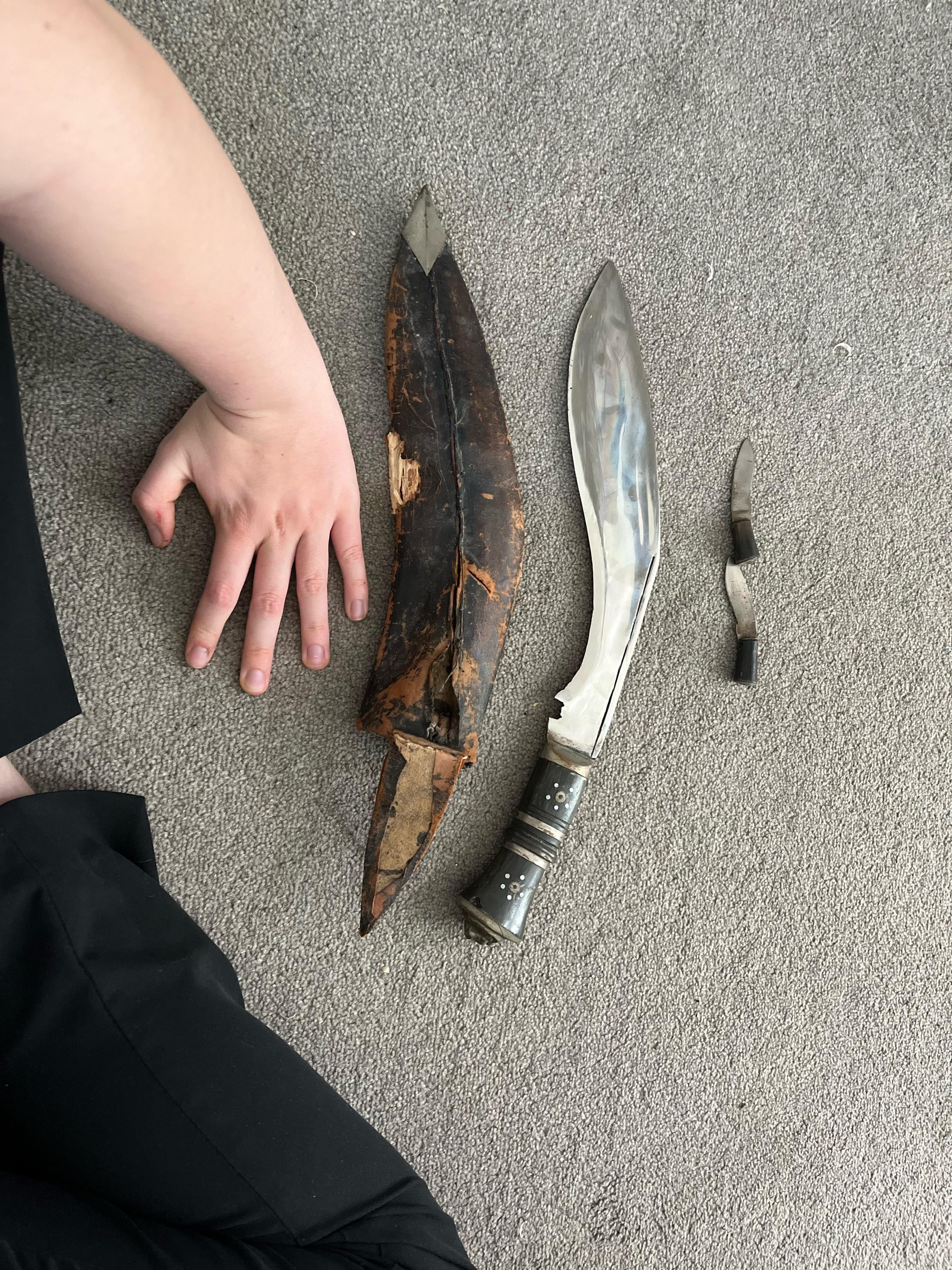
I believe it’s from between the 1950s-1980s I’m not sure. I have no history on this knife and how it was obtained, my dad was given it by his dad.
by SulfuxRiot

I believe it’s from between the 1950s-1980s I’m not sure. I have no history on this knife and how it was obtained, my dad was given it by his dad.
by SulfuxRiot

8 Comments
Did your grandad ever work with Gurkha soldiers?
It’s a Khukuri
Kukri
It’s a tourist Kukri, probably made in India. A good way to tell is if it has a lion on the pommel. The two small knives are a giveaway, too. Usually those get lost. A true Nepalese kukri has one dull and one sharp.
Its a Nepalese Khukri. The two small knife-like tools that generally accompany a Nepalese kukri are known as the Karda and the Chakmak. The Karda is small utility knife used small tasks skinning animals or preparing food. The Chakmak is more hardened and is used for hone the kukri and being used to throw sparks to start a fire.
It’s not unusual at all for them to be unbranded. The cutour shape in the back of it is called a Cho. No cho, no kukri. It keeps things like plant sap from running down the blade and making the handle slick. It may represent a cows hoof. A sacred symbol of Hindu God Kali. Seems like it could be a stress rise, but its a well tested design. It really does seem to benefit the knife in performance. Unfortuantely its not really traditional to mark them. The whole thing is one persons unique style. Or maybe it would be appliable to a whole village. They have come together to do some co-ops and incorporate some branding now. It does mean they can be faked, but if its hardened and finished properly, if the build quality is impressive then regardless of the origin it can be a great knife. Usually formed out of the carbon steel leaf springs they use in heavy trucks.
The cho on yours doesnt look great. Handle is not super traditional looking. I agree, prob Indian maybe Pakistani. Might still function okay. It’s not highly valuable as a keepsake, so the better memory is to use it if you have any need.
Indian made tourist kukri
Yeah, I’d make good use of it! 🥰
Read here for more info:
[http://sirkukri.blogspot.com/2015/08/the-gift-of-dying-gurkha-myths-vs-facts.html](http://sirkukri.blogspot.com/2015/08/the-gift-of-dying-gurkha-myths-vs-facts.html)
🫡