
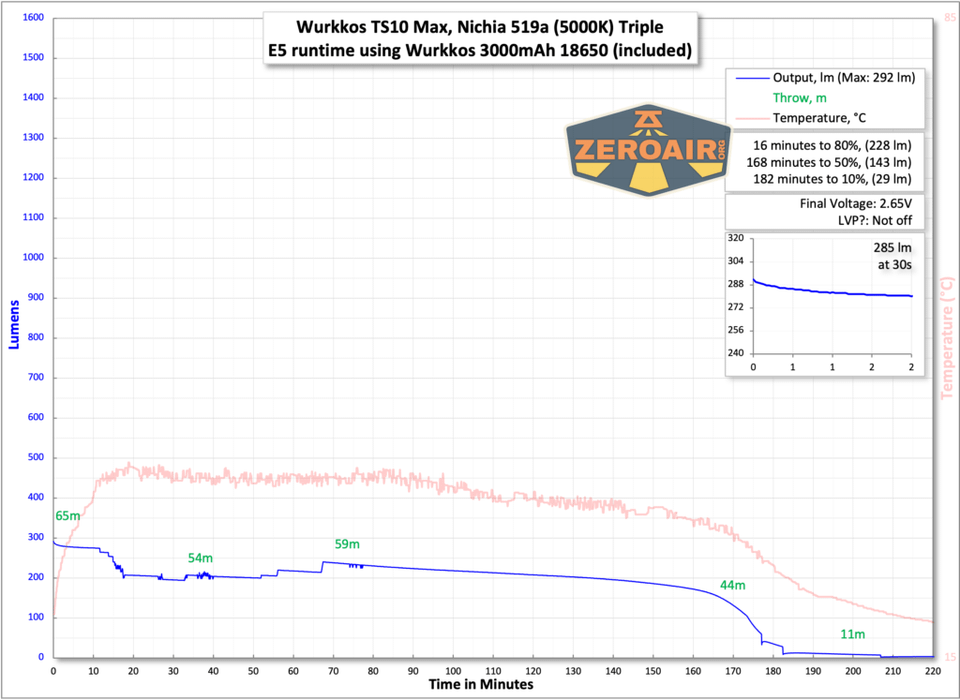
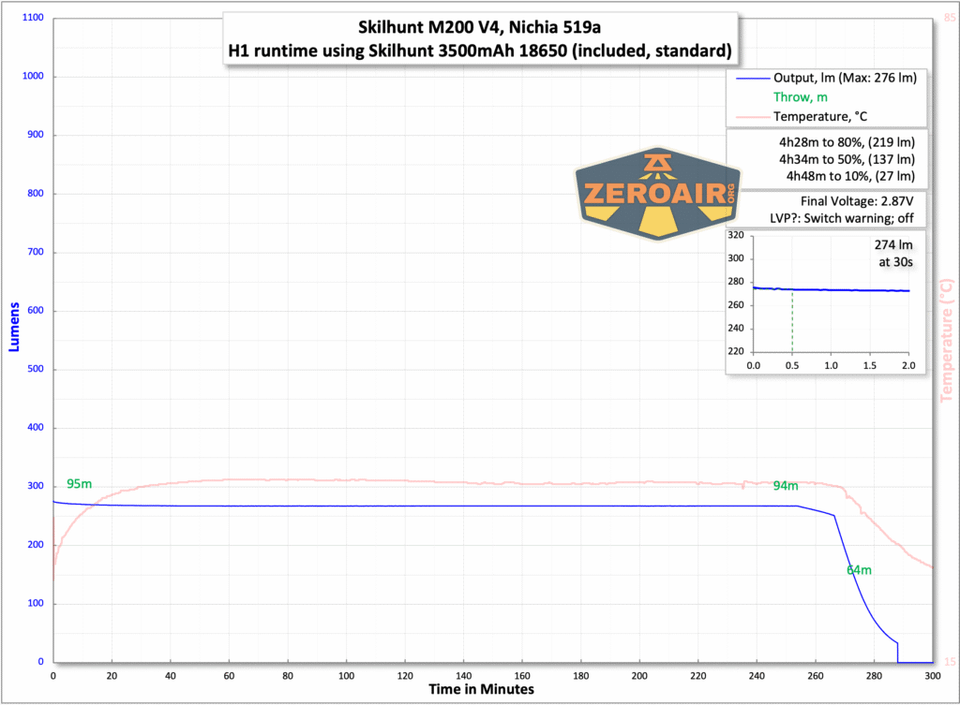
I've been looking for a smaller 18650 light with a 519a emitter and good battery life at moderate (~200 lm) brightness. A couple that caught my eye were the Skilhunt M200 v4 and the Wurkkos TS10 Max.
I had previously assumed that lights with similar batteries and similar emitters would have similar runtimes, so I was surprised to see the attached charts on ZeroAir.
How does the M200 get so much more runtime with the same battery format and emitter? Even if I used the TS10 Max all the way down to 29 lm before giving up that only gets it to 182 minutes. The M200 gives over 200 lm all the way out to 268 minutes! That's over 50% more usable runtime in my most used mode!
I understand that the M200 is a much more expensive light, and that its stock battery claims about 16% more capacity. But that's a lot more than 16% more runtime.
What is happening electrically here? Where does the wasted energy go in the TS10 Max? Is it all dissipated as heat? Why?
by sofauxboho

![[Review] Wurkkos HD05](https://www.edctips.com/wp-content/uploads/2026/04/omjwcxs19sug1-770x515.jpg "[Review] Wurkkos HD05")
5 Comments
Heat into the FET driver
The skilhunts use a switching driver (either boost or buck depending how the LEDs are wired)
It can efficiently convert the voltage from the battery to the voltage needed by the LED
In a FET driver, the LED forward voltage is needed is lower than the lithium ion battery voltage and it just burns it off as heat to make the difference
This is likely due to the audril driver being a linear/fet driver instead of a conventional buck/boost driver. Linear drivers use a variable resistor to burn off the extra voltage from the battery to match the led voltage. This results in reduced runtimes and increased heat. A fet driver is basically a solid state switch that directly connects the battery to the emitters and then rapidly turns on and off to change the brightness (often 2k+ times per second.) Since it is an e switch, the tail cap likely has a mosfet circuit to turn on the light which draws power and probably produces some heat as well.
A standard buck driver will step the voltage from the battery down to whatever the led wants which reduces heat and drain from the battery and increases overall efficiency.
It comes down to the difference in the drivers used, one being a FET and the other being a boost or buck driver.
It’s also a good illustration of why duty-use lights would benefit well from an SMPS (boost or buck) driver rather than an unregulated or FET+Linear driver.
Hi OP, other than the driver, keep in mind that:
M200 uses a reflector, usually has slightly higher optical efficiency than TIR optic, 5-10%
Buck vs linear at this level, usually about 15-20% gain
Battery difference, 17% more capacity
M200 has a exceptionally low LVP protection ~2.65V vs 2.8-2.9, about 2-5%
In total if you add them up or multiply them up you get ~50% gain in runtime. It’s not just the driver.
You’ve identified the biggest complaint about the TS10 Max. I don’t think the M200 is the right comp though – you should probably be looking at the EC200 which is more similar to the TS10 in offering 3 emitters.
The EC200 isn’t quite as efficient as the M200 (~20% less efficient), so you only get about 3 hours from the ~350 lumen mode. It’s not apples to apples because the lower mode is only 135 lumens. That mode would get you 10 hours!
The TS10 is a cool small 18650 light when you need it in spurts (eg around the house, most EDC usage, etc.). The Skilhunts and other more efficient lights are better for when you need multi-hour continuous usage. For the EDC type role, efficiency often doesn’t matter. You may only need it a few minutes per day and you can keep the battery charged by topping it off once a week but it’s not the one you would bring on an long outdoor excursion at night.