Well another poster mentioned that no one posts much about their worklights. So here we are!
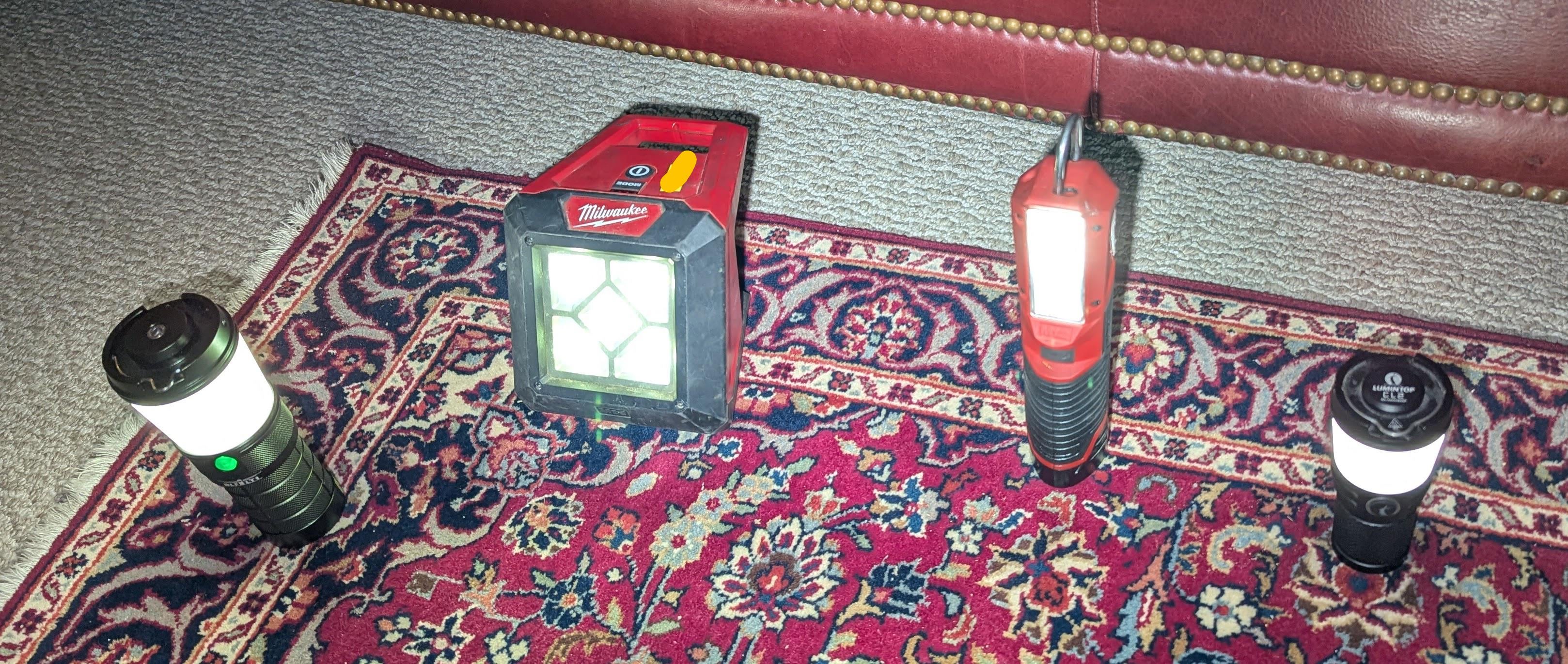
From left, Sofirn BLF-LT1; M12 Compact Flood Light 2364-20; Milwaukee M12 LED Stick Light 2351-20, and the Lumintop CL2 (discontinued).
Much has been written about the LT1, for those who are unfamiliar, it is a ~600 lumen lantern running on four 18650 cells with a built-in USB-C charger. The battery compartment is based on the common 4P compartments for high output throwers. Thoughtful features for practical use include a hoisting bail and two tripod mounts. This light has Anduril firmware and adjustable color temperature.
The M12 compact flood accepts Milwaukee M12 battery packs, which are 18650 batteries in either 3S or 3S2P configurations with some aftermarket vendors offering 3S3P. The light is bulky for what it is. But the size allows for the extended runtime of a pack with up to six cells, a magnetic base and a spring clamp that will allow the light to attach to 2x lumber as well as ledges, posts, pipes, and trees up to 1.5" diameter. It's shaped so that it can be set to point at a slight upward angle (as shown) or pointed straight up. Really a well thought out design from a practical use standpoint. There are three output levels. Milwaukee sells this as IP54 but in practice it's as watertight as many "enthusiast" flashlights with much higher ratings. It's supposed to be 1000 lumens continuous and probably is.
The sticklight also uses the M12 battery packs. It has a simple, clicky on-off switch and no modes or features. 220 lumens. I managed to fog the "chemical resistant" lens, probably with acetone or lacquer thinner, and had to buff it back out — while replaceable, the parts cost is over half the price of a new light. Anyway, design wise, this has a tripod mount on the back, and has a well-designed hook that latches into a number of different useful positions, in most cases for repair/maintenance work you can make the light face down towards whatever you're working on without much trouble.
Finally the CL2 has similar performance to the LT1 in a smaller package. It has a custom ROM rather than Anduril, and uses either AA nimh or 14500 INR cells. There's a bail and a bottom tripod mount.
==== compare and contrast ====
I use all of these as worklights for various kinds of repairs and maintenance. Cars, houses, boats, theater, shop. Like the rest of the cordless tool revolution, they save time and improve safety. In the "before times" I had to pull (and put away) extension cords to run halogen lights or drop lights (aka "trouble lights") and it was more common to install semipermanent work lights in areas that required frequent visits. Safety wise the battery lights have enough output for most purposes and no electrical shock hazard and reduced fire hazard. Many automotive repair shops back in the day were destroyed when a fire resulted from an accidental drop of a "drop light".
I like to use the lantern-type lights for area illumination when the power is disconnected and as a second "shadow fill" light when using more task-oriented lights (a smaller flashlight or something like the stick light) for specific areas. The compact flood has become a favorite for interior painting and varnishing as it provides intense light over a reasonably wide area.
The M12 packs work well in the environment where the lights are intended to be used. If I'm doing maintenace or repair work I always have a bunch of extra M12 batteries around. I can swap batteries in as needed and charge them later. The 3S and 2P3S packs are bulky by flashlight standards but it does simplify handling and improve safety, and eliminates the need to charge the batteries in the lights.
by Waterlifer