
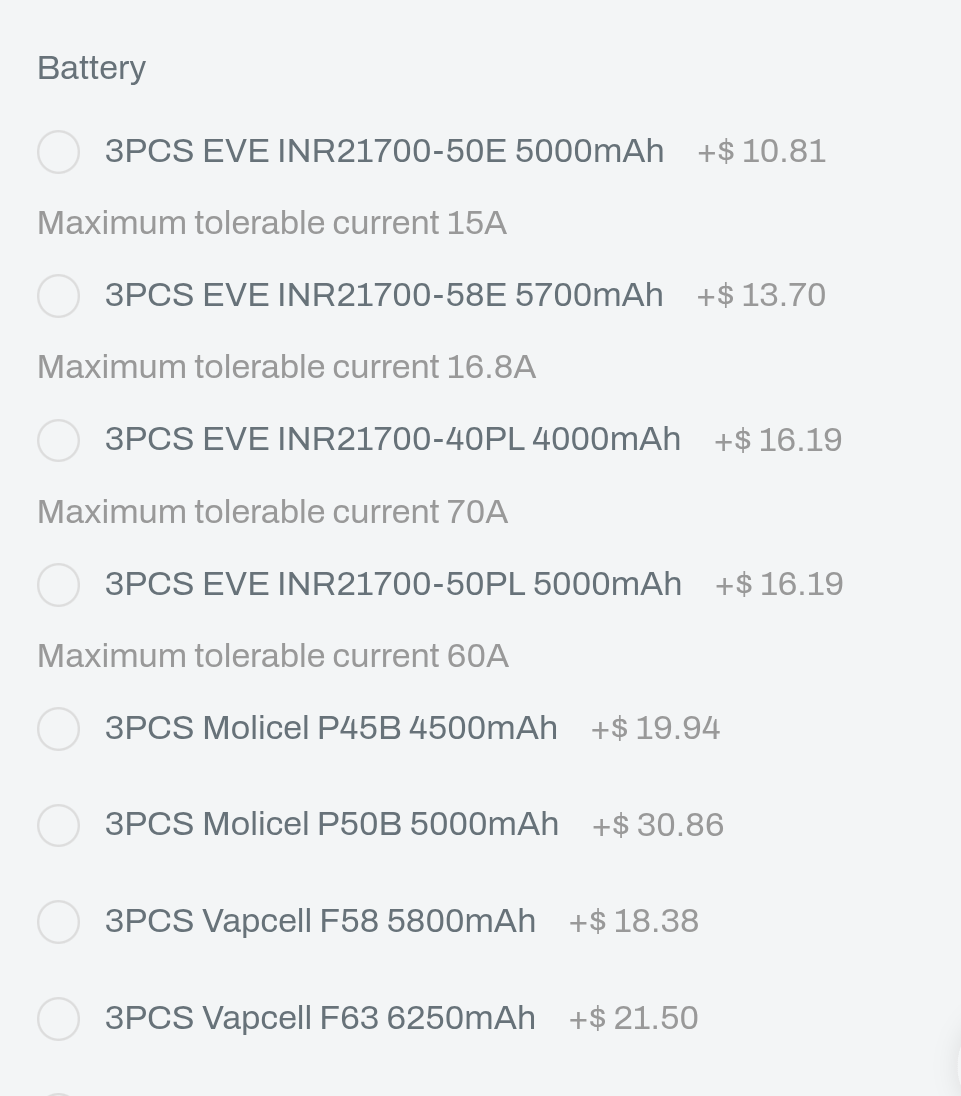
I haven't seen a post that talks specifically about this, but maybe I just missed it. When selecting batteries for a particular light, I've been using the rule of thumb to look for ones with a max output of at least double what the driver requires. So for a 10 amp driver, I look for batteries that provide at least 20 amps. After that, I just look for the ones with the highest capacity that I can reasonably afford.
Is that the general idea, or am I missing anything? Does the brand matter a lot? I'm not talking about Ali Express repurposed laptop cells. I mean from a reputable source like 18650 Batteries or from Convoy.
And speaking of Convoy, how do I read the battery selection? For example, in the above, I assume the current limit applies to the battery above rather than below. e.g. EVE INR21700-40PL is a 70 amp battery. What about the ones with no listed current? Is that a "do your own research" exercise or am I
Missing something?
Thanks!
by zenzic64


4 Comments
I usually go for 150%, so I would be okay using a 12.5A Vapcell in an 8A light but not a 10A light. Same principle, same reasoning, only different number. Li-ions don’t really start sagging until ~70% of CDR and 1/1.5 = 66.6% which is close enough.
It’s for the battery above.
The ones that are unlisted are ones that are fairly well-known among the people who even know who Simon is. High-mAh Vapcell 21700s have been 12.5A for as long as I can remember while the popular Molicels are their high-discharge ones. The older 21700s (P42A and P45B) are 45A tabbed cells while the new P50B is 60A.
If possible just get the Reliance RS50 and be done with it.
You are correct, the current is listed below the battery it applies to. The 50PL being 60A in your image, while the P45B below it has not got a listed rating (though it is a high rate cell)
This is just my personal take–FWIW and IMHO, to me, brand matters a good bit, as it often speaks to manufacturing quality and quality control capabilities, and the stakes are pretty high with unprotected lithium cells that hold a colossal amount of energy–when things go wrong with them, it can be very ugly. My personal preference is Molicel or Sanyo/Panasonic, as these are established original makers (i.e., they are not relabeled cells.) But there are many other brands with strong reputations, too. With brands that are relabeled cells (“rewraps”), there are some additional uncertainties/risks that you don’t have with an original manufacturer.
Convoy’s labeling may not always be 100% accurate–sometimes descriptions can be wrong and translations can get mixed up, especially with sites that have thousands of listings like Convoy’s site does. I do not recommend relying on it, but rather checking the individual specs of the cell you are considering to be 100% certain that it meets your desired specification. Spec sheets for lithium cells are generally pretty easy to find. [This](https://www.molicel.com/wp-content/uploads/Product-Data-Sheet-of-INR-21700-P50B-80122.pdf) is an example spec sheet. Mooch also has great testing data/recommendations on 18650 and 21700 cells that dives even deeper into things.
I don’t use the exact same rule of thumb as you, but I generally do like a lot of headspace between the cell’s rated peak amperage and what a light draws. If nothing else, this seems to benefit longevity. I also tend to prefer higher-drain cells because you can charge them harder without significant concerns about longevity impacts–my high drain 18650s and 21700s don’t mind 3A charging, and that’s actually on the lower end of the spectrum for what they can tolerate.
The Reliance RS50 and TenPower 50XG are arguably among the or the most advanced high-drain 21700s currently available (the Eve 50PL may be a good cell, but I don’t recommend it at this point until some self-discharge issues are cleared up.) Molicel is releasing the P60B, which should also be an extremely impressive 21700, but its timeline has been slightly delayed.