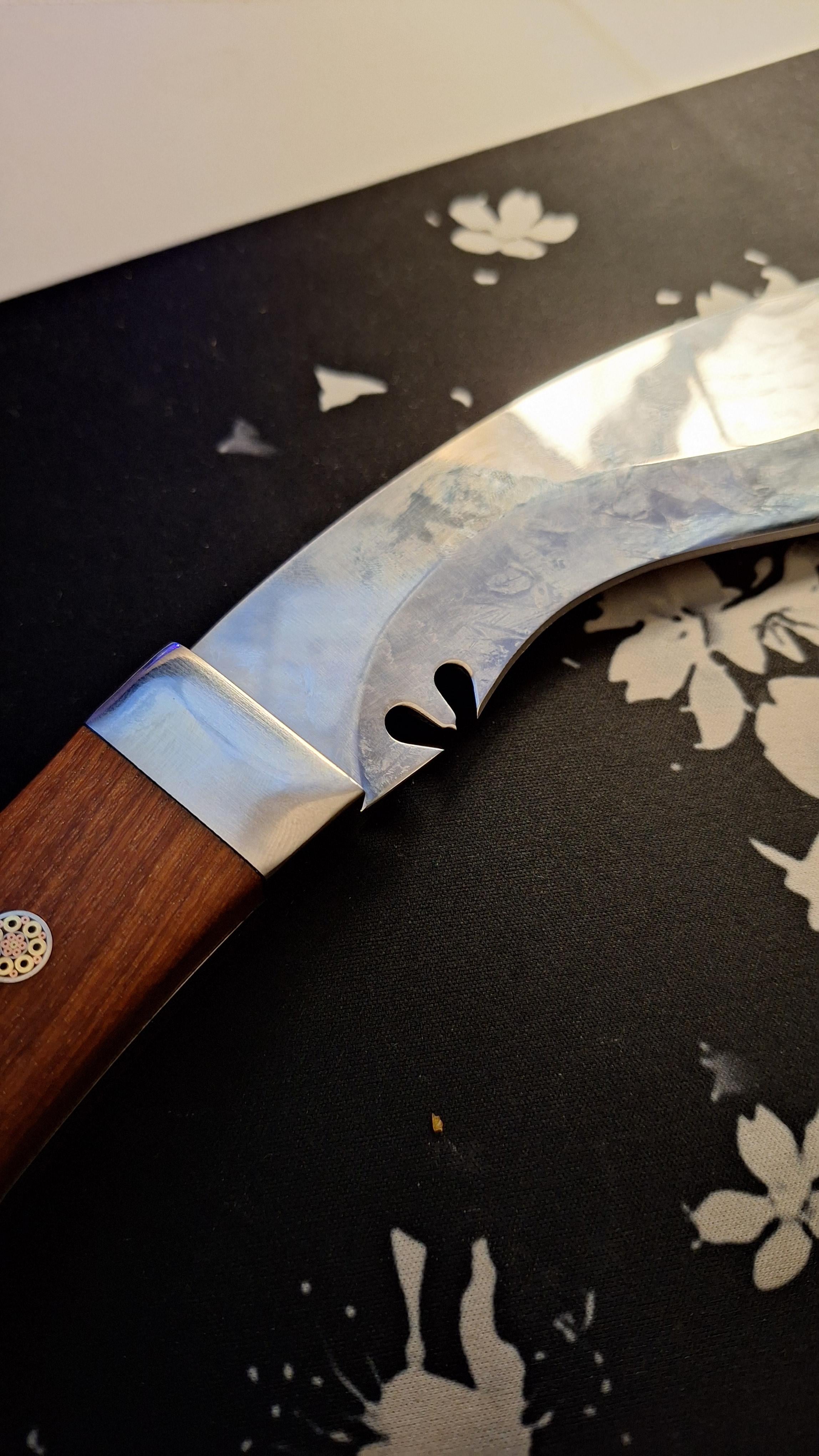
That’s a cool gift! That notch is called a Cho or a Kaudi. There is no historical record that specifically describes a single purpose but there are several traditional and practical explanations for them. Historians believe it could have religious relevance. It could be a trident which symbolizes Shiva in Hindu religion. Some say it symbolizes a cow hoof as cows are sacred in India. There are also practical explanations that it works as sharpening stop or a blood or sap stop designed to keep the handle clean. Though these practical applications seem to be pretty heavily disputed by historians.
Neco-Arc-Brunestud
Sharp edges are susceptible to fatigue cracking. This includes blades.
A kukri has its thinnest cross-section at the base of the blade. That induces a point of weakness.
The way you get around that is to create an area with a thinner cross-section and make it rounded. That way you don’t get microfractures that propagate with repeated use.
That essentially turns the knife into a spring.
With this design, you get slightly less blade but also more fatigue strength.
anamos7
Slice a few people with it and you will understand its need.
Telugu_pacman
Kukri is a combat weapon, and when cut through flesh the blood will drip on to the handle and you’d lose the grip.
With the help of this notch or similar notches, the blood will be caught and drip down to the ground instead of your hand
LuigiBamba
Weird coincidence, just a few hours ago an aunt of mine was invited for supper and we ended up talking about her trip to nepal 10 years ago.
They bought a bunch of these and were told that the notch was to prevent the blood of their enemies from reaching the grip and making it slippery.
Ti_Magg
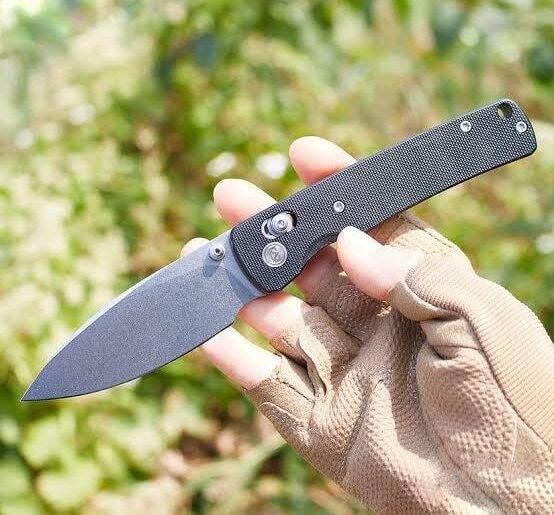
I would say a form of a Spanish Notch, debatable purpose.. decorative, functional for fighting, sharpening choil.

7 Comments
Search for “[Spanish Notch](https://www.startpage.com/do/dsearch?q=spanish+notch&cat=web&language=english)”
That’s a cool gift! That notch is called a Cho or a Kaudi. There is no historical record that specifically describes a single purpose but there are several traditional and practical explanations for them. Historians believe it could have religious relevance. It could be a trident which symbolizes Shiva in Hindu religion. Some say it symbolizes a cow hoof as cows are sacred in India. There are also practical explanations that it works as sharpening stop or a blood or sap stop designed to keep the handle clean. Though these practical applications seem to be pretty heavily disputed by historians.
Sharp edges are susceptible to fatigue cracking. This includes blades.
A kukri has its thinnest cross-section at the base of the blade. That induces a point of weakness.
The way you get around that is to create an area with a thinner cross-section and make it rounded. That way you don’t get microfractures that propagate with repeated use.
That essentially turns the knife into a spring.
With this design, you get slightly less blade but also more fatigue strength.
Slice a few people with it and you will understand its need.
Kukri is a combat weapon, and when cut through flesh the blood will drip on to the handle and you’d lose the grip.
With the help of this notch or similar notches, the blood will be caught and drip down to the ground instead of your hand
Weird coincidence, just a few hours ago an aunt of mine was invited for supper and we ended up talking about her trip to nepal 10 years ago.
They bought a bunch of these and were told that the notch was to prevent the blood of their enemies from reaching the grip and making it slippery.
I would say a form of a Spanish Notch, debatable purpose.. decorative, functional for fighting, sharpening choil.