For years I envied people that put tritium vials in their lights, so I gave in and decided to make my own poor-man’s version of them for some of my zebralights. Kind of. They’re closer to poor-man’s lighted tailcaps.
I bought some glow-in-the-dark powder (strontium aluminate with europium & dysprosium), which is supposed to be the best GITD material you can get. I mixed it into clear epoxy and then put dollops on the ends of my zebralights. Sanded flat so they could tail-stand again, then sat back at night and enjoyed the show.
It is amazingly bright for the first few minutes, and then provides a gradually dimming glow all night long that is still easily seen with dark-adapted eyes at the end of the night. I will have no problem finding those lights in the dark. I’ll still misplace them in the day, though.
You don’t actually have to “charge” the GITD material. It will glow just fine after being exposed to normal room lighting. You will just miss those first few minutes where it glows really bright. I think it definitely outshines moonlight settings on flashlights, at least for those first few minutes.
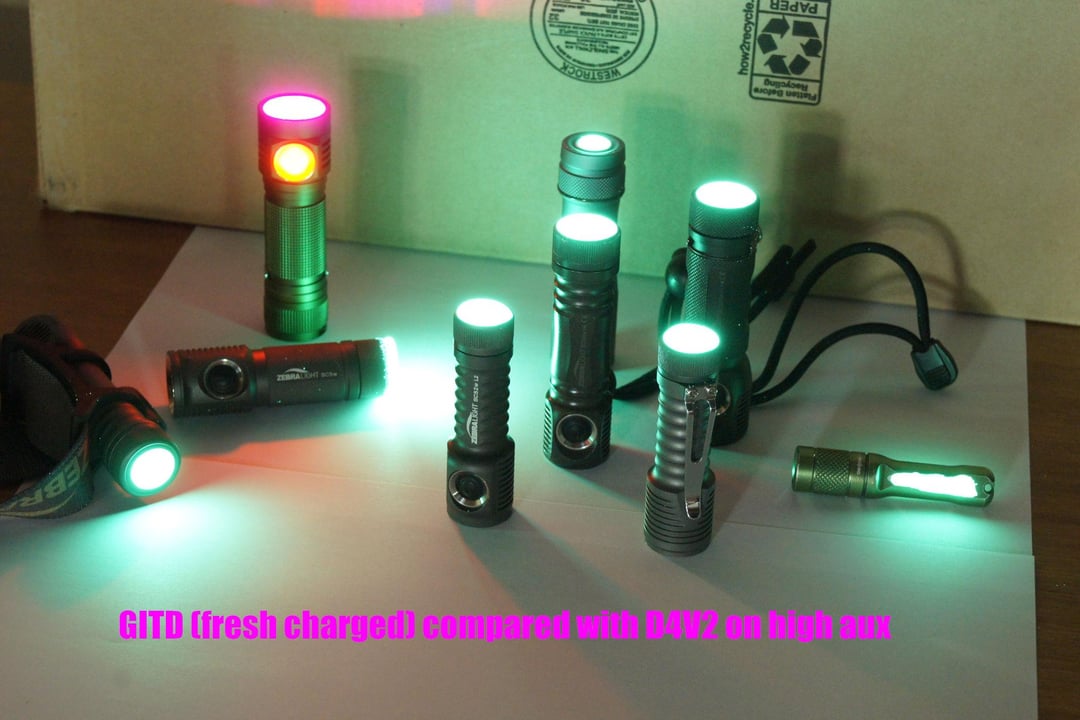
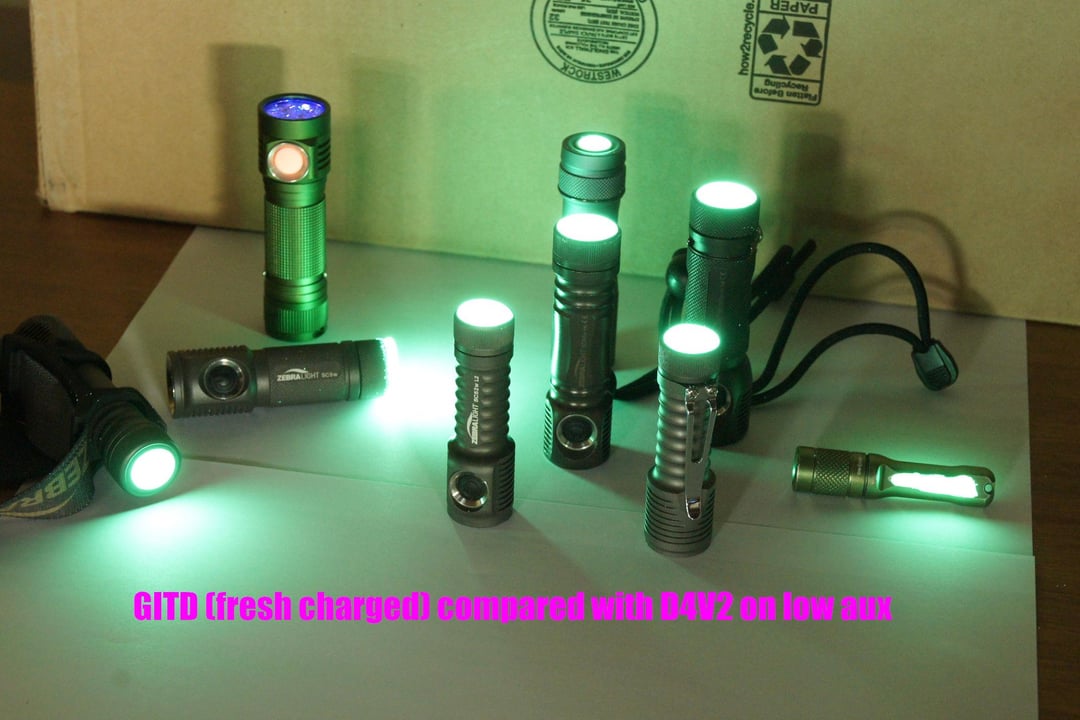
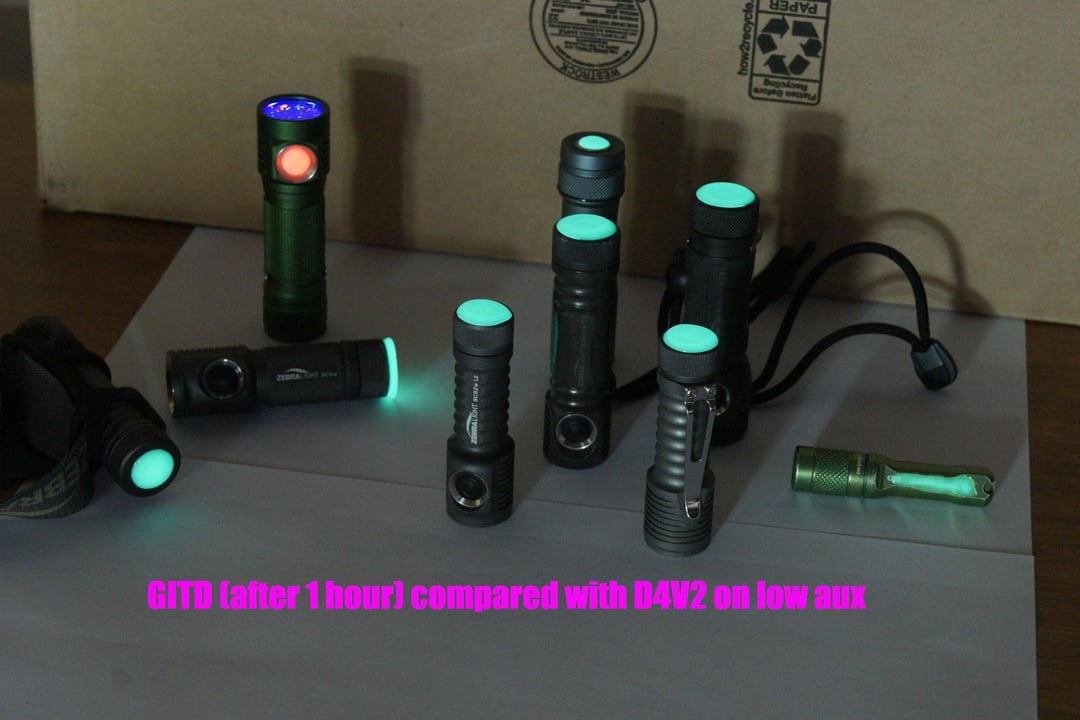
In my photos, I placed a Emisar D4V2 with an amber switch and purple aux lights for comparison. You can see that the Emisar on low is way dimmer than my GITD tail lights. With the D4V2 aux on high, the GITD lights still outshine the amber switch by a large amount. I think the high aux lights on the front of the D4V2 are closer in brightness to the GITD tails.
I also included photos showing the results after 5 minutes, and after 1 hour.
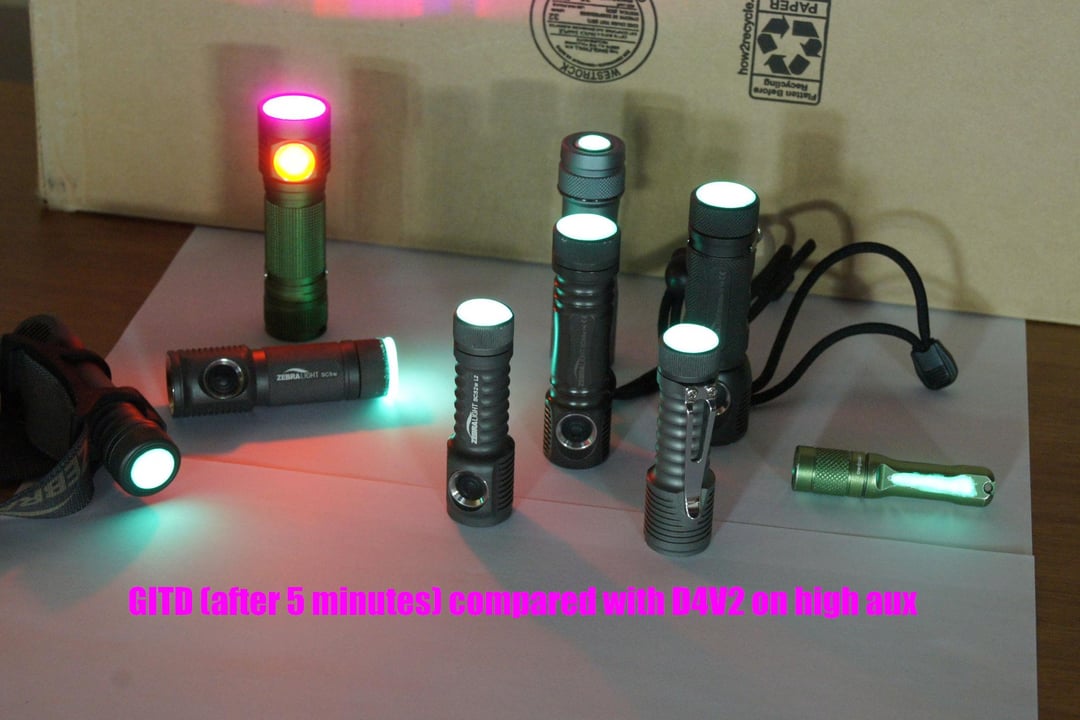
5 minutes shows the GITD lights are still almost as bright as the D4V2 switch on high. This is about what you can expect if you don’t “charge” them with a bright light.
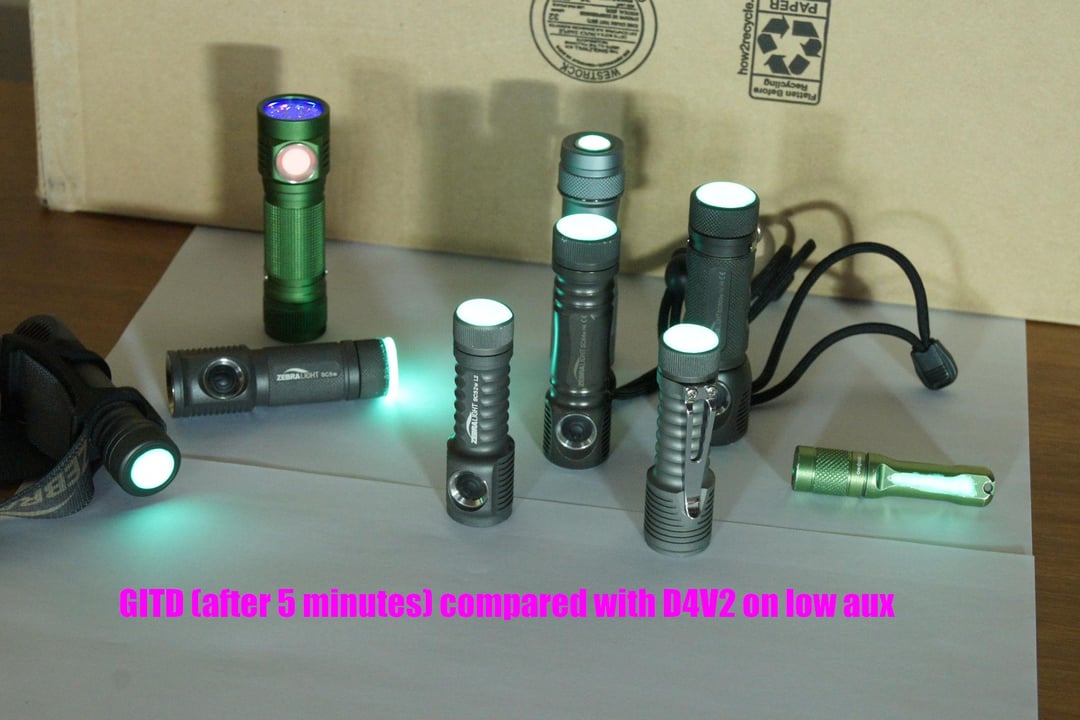
After 1 hour they have dimmed a lot, but they’re very easily seen in a dark room. The D4V2 on low aux is there for comparison and the GITD still outshines it.
Overall, it looks a bit ugly, but I’m very impressed by how bright glow-in-the-dark powder is nowadays. This stuff (strontium aluminate) was apparently discovered in the 1990’s, and beats the previous GITD zinc sulphide by about 10x in brightness and 10x in how long it lasts. It’s about 10x the cost too, so the old stuff is still commonly used on cheap GITD products.

1 Comment
For years I envied people that put tritium vials in their lights, so I gave in and decided to make my own poor-man’s version of them for some of my zebralights. Kind of. They’re closer to poor-man’s lighted tailcaps.
I bought some glow-in-the-dark powder (strontium aluminate with europium & dysprosium), which is supposed to be the best GITD material you can get. I mixed it into clear epoxy and then put dollops on the ends of my zebralights. Sanded flat so they could tail-stand again, then sat back at night and enjoyed the show.
It is amazingly bright for the first few minutes, and then provides a gradually dimming glow all night long that is still easily seen with dark-adapted eyes at the end of the night. I will have no problem finding those lights in the dark. I’ll still misplace them in the day, though.
You don’t actually have to “charge” the GITD material. It will glow just fine after being exposed to normal room lighting. You will just miss those first few minutes where it glows really bright. I think it definitely outshines moonlight settings on flashlights, at least for those first few minutes.
In my photos, I placed a Emisar D4V2 with an amber switch and purple aux lights for comparison. You can see that the Emisar on low is way dimmer than my GITD tail lights. With the D4V2 aux on high, the GITD lights still outshine the amber switch by a large amount. I think the high aux lights on the front of the D4V2 are closer in brightness to the GITD tails.
I also included photos showing the results after 5 minutes, and after 1 hour.
5 minutes shows the GITD lights are still almost as bright as the D4V2 switch on high. This is about what you can expect if you don’t “charge” them with a bright light.
After 1 hour they have dimmed a lot, but they’re very easily seen in a dark room. The D4V2 on low aux is there for comparison and the GITD still outshines it.
Overall, it looks a bit ugly, but I’m very impressed by how bright glow-in-the-dark powder is nowadays. This stuff (strontium aluminate) was apparently discovered in the 1990’s, and beats the previous GITD zinc sulphide by about 10x in brightness and 10x in how long it lasts. It’s about 10x the cost too, so the old stuff is still commonly used on cheap GITD products.